
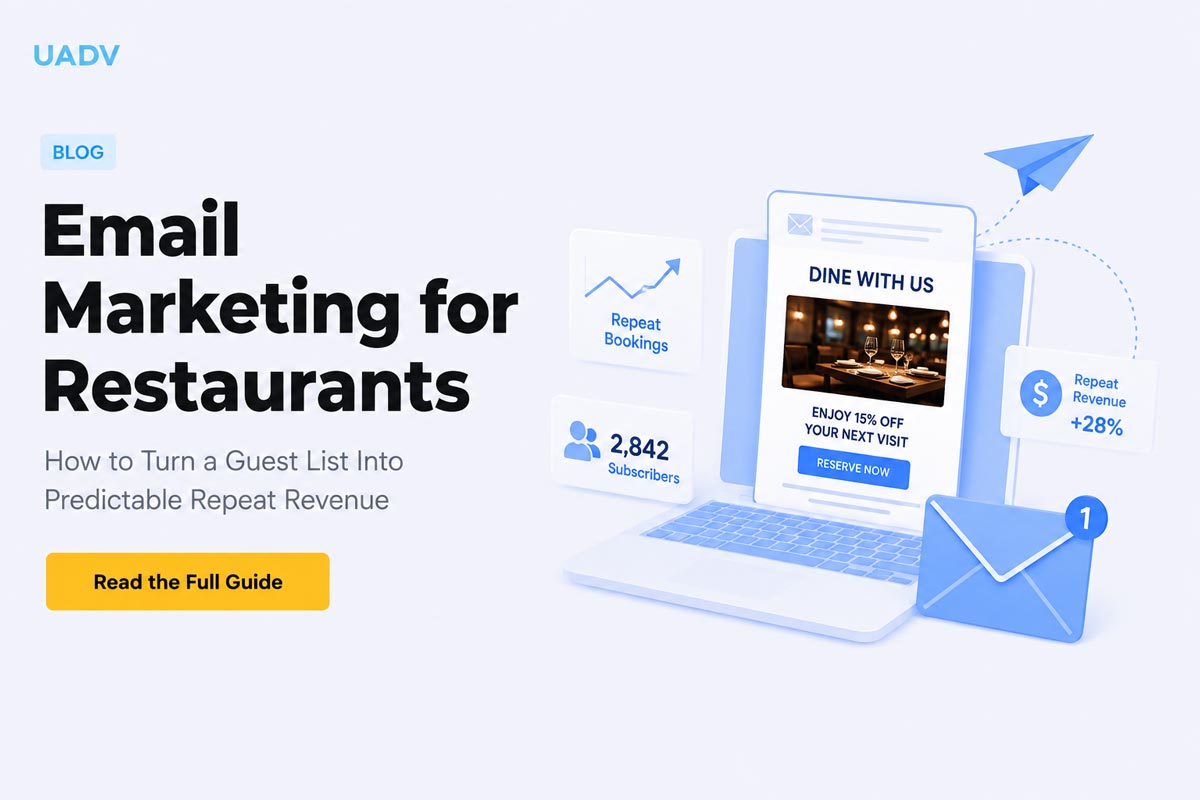
A 200-cover Saturday puts hundreds of people through your dining room. You cooked for them, you talked to them, several of them told you it was the best meal they had eaten all month. And on Sunday morning you have no way to reach a single one of them.
That gap is the whole problem, and almost every restaurant has it.
Email marketing for restaurants is the cheapest reliable way to make a guest come back, and it is the only marketing channel a restaurant fully owns. No algorithm decides how many people see it. No marketplace charges you a percentage of the check for the privilege. Nobody can change the rules on it next quarter.
People ask whether email marketing actually works for restaurants. The short answer is yes, but only when it runs on guest data rather than a static contact list, which is the difference between a system that fires when a guest is receptive and a list you blast when you need covers.
Here is the part that matters. Most restaurants already have an email list, and it is already underperforming. The reason is almost never the copy, the design or the subject lines, which is exactly what every guide you have read so far has tried to fix. This is the build order our team at UADV uses when we take over email for a restaurant client, in the sequence an operator would actually execute it: how to work out what your list is worth, how to build it, the four sequences that generate most of the revenue, how to choose a platform based on your POS rather than a feature chart, and the deliverability rules that quietly kill restaurant email programs.
No software is being sold here. We do not resell platforms and we do not take vendor commissions, which means the recommendations below can say when the free tool built into your POS is the right answer. If you want the wider channel picture first, start with our restaurant marketing strategy guide.
The short answer is that a well-run restaurant email list is worth somewhere between one and four dollars per subscriber per year in incremental revenue, and most restaurant lists are earning close to nothing.
That range is wide because it depends almost entirely on whether the list is connected to guest behavior. It is also the number worth calculating before you spend anything, because it turns email from a marketing chore into a line item you can compare directly against a platform subscription or an agency retainer.
You have probably seen the return-per-dollar statistic that opens nearly every article on this topic. We are leaving it out unless it comes with a publishing body and a year attached, because a number that has been copied between blogs since 2019 tells you nothing about your restaurant in 2026.
What is worth understanding is why email is structurally different from your other channels. Social reach is rented and has been declining for years. Third-party delivery marketplaces own the guest relationship and charge you for access to it. Paid ads stop producing the moment the budget stops. The email list is the only guest asset you keep, and it is the only one that appreciates.
One framing to carry through the rest of this: the revenue comes from repeat visits, not new ones. Email is a retention channel that occasionally acquires, not an acquisition channel. Every recommendation below follows from that.
The calculation fits on a napkin. Subscribers, multiplied by the share who visit because of an email in a year, multiplied by your average check.
Take a list of 3,000 subscribers. Suppose 12 percent of them make one visit in a year that was genuinely prompted by an email, so 360 visits. At a $55 average check, that is just under $20,000 in revenue attributable to email. Now run it again with the segmentation from later in this article, where the same list produces a 20 percent rate because the messages are triggered by behavior rather than sent on a schedule: 600 visits, roughly $33,000. Same list, same food, same subject lines. The difference is entirely structural.
That number matters more than your open rate for a simple reason. Your open rate cannot be compared to anything on your P&L. Revenue per subscriber can be compared to the cost of the platform, the cost of the hours someone spends writing the emails, and the cost of an agency if you are weighing one.
The honest caveat, which no vendor page will give you, is that attribution in a restaurant is imperfect. A guest who books after opening your email may well have booked anyway. The only clean way to know is a holdout group, meaning you withhold the campaign from a small random slice of the segment and compare visit rates between the two. Anything else is a directional estimate, and you should treat it as one.
The list is a pile, not a database. Names and addresses with no visit history attached mean every send is a blast to everyone. A blast is the lowest-yield format email has, because the message that would bring back a lapsed guest is not the message that makes a regular feel recognized.
Everything is a broadcast and nothing is triggered. Restaurants send when they remember to, which in practice means they send when the restaurant needs covers. That is precisely the wrong timing signal. The right signal is when the guest is receptive, and the guest does not know your Tuesday is soft.
The email tool is disconnected from the systems holding the data. Your POS knows who came in on Tuesday. Your reservation system knows who booked and who did not show. Your email platform knows neither, so every segment you build is a guess dressed up as a strategy.
Here is what most people don’t realize: none of these three problems are fixed by better copy. Nearly every guide on this topic sells better copy, because better copy is what a content marketer knows how to write about. The constraint is plumbing.
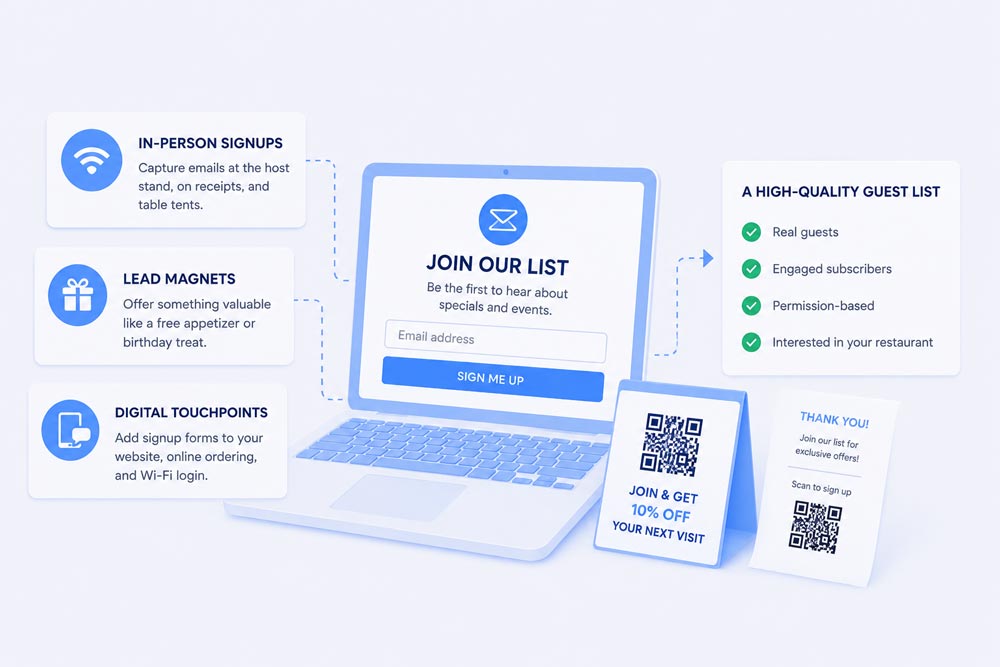
Restaurants collect email addresses in five places, and four of them require no extra work from staff during service.
That constraint deserves stating before any tactics, because it eliminates most conventional advice immediately. Anything that slows a server down during a Saturday rush will not survive contact with your floor. It will work for two weeks while someone is watching and then quietly stop.
So separate the two kinds of capture. Passive capture happens automatically inside systems you already run, and it scales without anyone remembering to do it. Active capture asks a human being to do something, and it does not scale. Build the passive infrastructure first and treat active capture as a supplement.
One more thing before the tactics. What you capture alongside the address matters as much as the address. A contact record with a visit date, a check total and a birthday is worth several times a contact record with only an email address, because the first can trigger sequences and the second can only receive blasts.
Reservation systems. Every booking through OpenTable, Resy, SevenRooms or Toast Tables already carries a contact record with a visit date attached. The only real question is whether that data is flowing into your email platform, and for most restaurants the answer is no. This is usually the single highest-value fix available.
Online ordering and delivery. Direct ordering through your own site captures the guest. Third-party marketplaces largely do not pass guest contact data through to you, which is one of the strongest arguments for pushing guests to order direct even at similar economics.
Guest Wi-Fi sign-on. High volume, essentially zero friction. Worth knowing that addresses collected here are lower-intent than reservation addresses, because the guest wanted internet rather than a relationship, so segment them separately rather than mixing them in and dragging your engagement rates down.
POS-integrated digital receipts. The guest is already being asked whether they want the receipt emailed. This is the least intrusive capture point in the building and it comes with a check total and a visit date attached.
Table-top QR codes tied to something the guest actually wants. Not “join our newsletter,” but a birthday club, an early-access list for chef’s table dinners, or a waitlist for the next tasting night. The specific framing outperforms the generic one substantially, because the guest can see what they get.
Your website matters here too. Signup placement on your restaurant website is worth getting right, and social media marketing for restaurants covers converting social followers into list members.
The best incentive is access, not a discount. A discount trains the guest to wait for the next discount, and it permanently compresses margin on a business already operating on very little of it.
Rank offers by what they do to your margin over time. Early access to event bookings costs nothing. Birthday recognition costs nothing. First look at a seasonal menu costs nothing. A percentage off every visit costs you forever, and it is remarkably difficult to withdraw once guests have come to expect it.
If you do use a discount, make it one-time, first-visit-only, with an expiry. The mechanical reason matters. A one-time offer converts into a second visit, which is exactly the job. A standing offer converts into an expectation, which is the opposite of the job.
On double opt-in, it is a genuine fork, so decide deliberately. You get a slightly smaller list and a materially better complaint rate and deliverability profile. For any restaurant that will cross into bulk-sender territory, and that includes most restaurants with a list above a few thousand, the trade is worth it.
New guests, one visit. The only goal is a second visit. Judge everything you send this segment against that single outcome and nothing else.
Repeat guests, two to three visits. The goal is habit formation, which means consistency of contact matters more than the strength of any individual offer.
VIP guests, four or more visits or above a spend threshold you set. The goal here is recognition rather than promotion, and the tone should shift accordingly. These people do not need convincing; they need to feel known.
Lapsed guests, no visit in 30, 60 or 90 days depending on your natural visit frequency. The lapse window is not universal, and copying someone else’s is a common and expensive error. A neighborhood lunch spot where regulars come weekly and a special-occasion restaurant visited twice a year have completely different clocks.
The real constraint is maintainability. Four segments that update automatically from POS or reservation data will outperform twelve segments that depend on someone maintaining a spreadsheet, because nobody maintains the spreadsheet. They maintain it for a month.
In four sequences, a restaurant can automate most of the email revenue it will ever earn: a welcome series, a post-visit follow-up, a win-back, and a birthday flow.
The distinction underneath this is the concept most operators are missing. A campaign goes to a list on a date you choose. A sequence fires for one guest on a date their behavior chooses. The second consistently outperforms the first, because it arrives when the guest is receptive rather than when your Tuesday needs help.
Each of the four below is specified the same way: trigger, delay, message count, the job each message does, and the one metric that tells you whether it works. If you can only build one, build the win-back. It targets guests who have already proven they will spend money with you and requires no new acquisition at all.
This section covers restaurant-specific sequence architecture. For the underlying craft, meaning subject line testing, send-time optimization and design, our email marketing best practices guide covers that ground for any business and there is no reason to restate it here.
Trigger: list join · Delay: first message within one hour · Messages: 2 to 3 over roughly 10 days · Metric: second visit within 60 days
Give each message one job. Message one confirms the signup and sets expectations for what they will receive and how often, and this is also where you earn the right to keep sending. Message two tells the restaurant’s story or introduces the chef. Message three carries the single conversion ask.
Hold the offer until message three rather than leading with it. Opening with a discount anchors the entire relationship on price before the guest has been given any other reason to value you, and you cannot un-anchor it later.
The metric is the percentage of new subscribers who record a second visit within 60 days. Not open rate. Not click rate. A second visit.
If your platform supports branching, build one. Someone who joined at the table has already eaten your food and needs a completely different message one from someone who joined through your website and never has.
Trigger: closed check or completed reservation · Delay: 2 to 48 hours · Messages: 1 · Metric: feedback response rate
The window is short because the guest’s memory of the meal is the asset, and it decays quickly. A follow-up that arrives five days later is competing with four other dinners.
The message has two jobs and the order matters. Thank first. Ask for feedback second. Then, and only then, make it easy for happy responders to leave a public review. That sequencing is also what catches a dissatisfied guest privately, in an email you can respond to, rather than publicly in a review you cannot.
One important boundary: ask every guest for feedback and make the review request equally available to all of them. Selectively soliciting reviews only from guests you expect to be positive violates Google’s review policies and can run into FTC endorsement guidance. Build it as one path for everyone.
Measure the feedback response rate, and separately track the share of negative feedback you resolved before it became a public review. That second number is the one that protects your rating.
Trigger: your own lapse threshold · Delay: roughly one week between messages · Messages: 3, then suppress · Metric: reactivation rate within 30 days
Escalate deliberately across the three. Message one is a soft “we haven’t seen you” with something genuinely new to come back for. Message two carries a real, expiring incentive, and this is the one place a meaningful offer earns its cost, because these guests are otherwise gone. Message three is the last-chance note, and it should also offer a clean way off the list.
Suppression after the sequence is not optional. Continuing to email someone who has ignored three win-backs is the fastest way to raise your complaint rate, and a complaint rate does not damage that contact’s deliverability, it damages deliverability for everyone on your list.
One timing nuance worth building in: if your restaurant is seasonal, firing win-backs into a dead month wastes the strongest offer you will send all year. Run them just ahead of a period when the room can absorb the covers.
Trigger: birth date · Delay: fires 7 to 10 days before the date · Messages: 1 to 2 · Metric: bookings per email sent, and average party size
This is the only email a restaurant sends that arrives on a date when the guest is already planning to eat out and already deciding where. You are not creating demand. You are showing up at the exact moment demand exists.
Fire it seven to ten days ahead, not on the day. The booking decision for a birthday dinner is made in advance, so an email on the morning of arrives after the choice was made.
Build the offer around a party rather than an individual. A free dessert brings one person. A complimentary bottle for the table, or a held reservation for a group, brings six covers and a substantially larger check. This is the single highest-leverage change most restaurants can make to this sequence.
The prerequisite is data, and it is where most restaurants stall. You need a birth date, which means asking for it at capture. Day and month only. It is less intrusive to ask for, guests are more willing to give it, and it carries less data-privacy liability than a full date of birth.
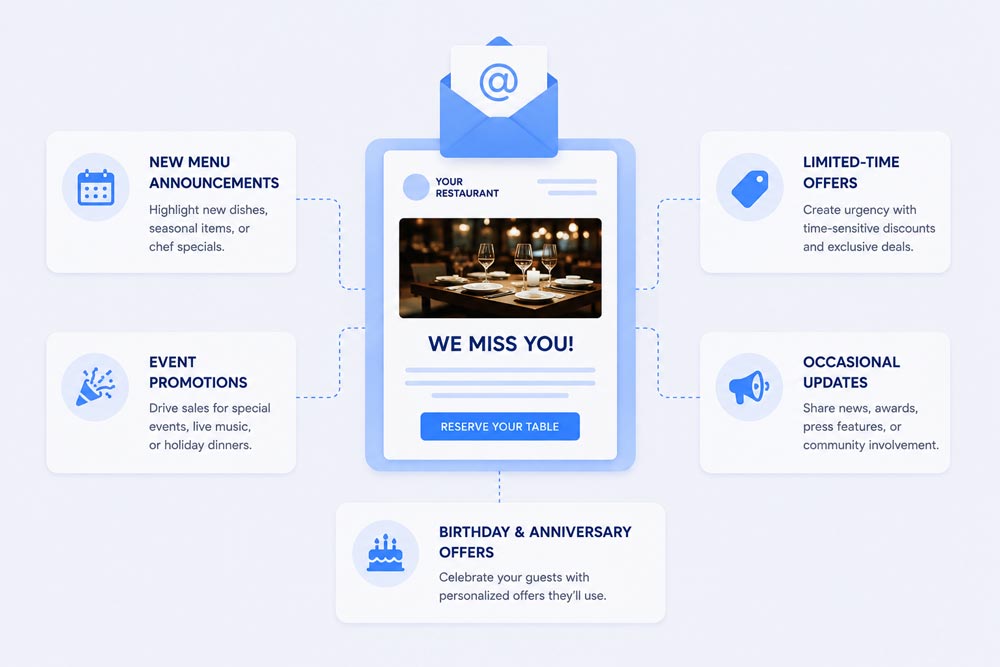
The difference between a sequence and a campaign is who chooses the timing, and most restaurants send far too many campaigns and far too few sequences.
Once your four sequences are running, broadcast volume should go down, not up. The sequences are already carrying the retention load, which frees broadcasts to do the thing they are actually good at, which is announcing something that is genuinely new.
Four broadcast types reliably earn their place. A real menu change or seasonal shift. A ticketed or one-off event. A slow-night offer aimed at a specific segment rather than the whole list. And a private-events or group-booking push aimed at your VIP segment.
What does not earn its place is the monthly newsletter with no news in it. Sending on a schedule rather than sending when you have something to say is one of the most common causes of a climbing unsubscribe rate, and it is entirely self-inflicted.
That private-events broadcast deserves a note. It is frequently the highest-revenue email a restaurant sends all year and it is also the one most often skipped, because operators think of email as a covers channel rather than a buyout channel. One holiday party booking can exceed a month of promotional sends.
Two to four broadcast emails a month suits most independent restaurants, with automated sequences firing on top of that and not counting toward the total.
But the number is a starting point, not a rule. What actually governs your ceiling is your own complaint and unsubscribe rate, and that is the diagnostic worth learning. If unsubscribes climb as you add sends, you have found your ceiling. If they do not move, you have room.
It genuinely varies by format. A fast-casual spot whose guests visit weekly can send more than a special-occasion restaurant a guest visits twice a year, and applying one cadence to both is a mistake in one direction or the other.
Increase deliberately. Add one send a month, watch the complaint rate for a full cycle, then decide. Picking a number and holding it for two years tells you nothing.
Specificity beats cleverness, reliably enough to treat as a rule. “Tuesday, six oysters, twelve dollars” outperforms “You won’t believe what we’re doing this week,” because a guest scanning an inbox is deciding whether the email is relevant, not whether it is entertaining.
A few rewrites in restaurant context:
Respect the mechanics. Keep it short enough to survive mobile truncation, and treat preview text as a second headline rather than as wasted space, because most restaurants leave it as the platform default, which is a free improvement sitting unused. Emoji use is inconsistent enough across audiences that it should be tested rather than assumed either way.
One correction most guides have not made: subject-line A/B testing has become much harder to read since Apple Mail Privacy Protection began pre-loading images and inflating open rates. Test against clicks or bookings instead.
Here’s what most people don’t realize. Your POS and reservation system have already narrowed your email platform choice to two or three options, and comparing feature lists before you know that is wasted time.
The reason sits in everything above. Restaurant email only outperforms a generic newsletter when it fires on real guest behavior, and behavior lives in the POS, the reservation system and the ordering platform. A tool that cannot read those systems cannot run any of the four sequences in this article. It can only send broadcasts, which is the format we just established produces the least.
This article recommends no single platform, and that is a feature rather than a hedge. UADV sells no software and takes no vendor commissions, which means the honest answer here genuinely depends on your stack rather than on what we have to move.
[Decision 1 open — the platforms below are named factually and never ranked, per the outline’s keyword table. If the client is not comfortable naming tools UADV does not sell, this section converts to category-level language. Flag before publish.]
Reservation-led. If more than half your covers come through bookings, the guest record lives in your reservation system, whether OpenTable, Resy or SevenRooms, and your email tool needs to read from it. This is the common shape for fine dining, hotel food and beverage, and anywhere the host stand is the front door.
POS-led. If walk-ins and counter service dominate, the guest record lives in the POS instead, whether Toast, Square, Clover or Lightspeed, and your email tool should read from there. This is the shape for fast casual, cafés and quick service.
Ordering-led. If direct online ordering and delivery make up a large share of revenue, your data is fragmented across several systems and usually needs a layer that stitches guest profiles together before email can be personalized at all. This is the most expensive shape to solve and the one most likely to justify a dedicated platform like Klaviyo.
Two questions resolve your own case. Where does the majority of your guest data get created? And can the email tool read that system natively, or only through a manual export? A tool that requires someone to download a CSV cannot run triggered sequences, and that single test eliminates most of any shortlist before you have compared a feature.
[Data point — POS and reservation integrations change frequently and without announcement. Verify every named integration against current vendor documentation within 30 days of publishing, and re-verify every 90 days.]
If your POS or reservation platform already includes email and you run one location, that is usually the right answer. Adding a standalone tool adds a cost line and a sync problem without adding revenue.
Four conditions justify moving to a dedicated platform: multiple locations with a shared guest database, a list well into the tens of thousands, genuinely complex branching logic, or a built-in tool whose automation simply cannot express the four sequences above. Absent one of those, the migration is work without a return.
The trade-off runs in both directions and it is worth stating honestly. Built-in tools win on data integration and lose on email features and design control, and you will hit limits on templates and logic. Dedicated platforms like Mailchimp, Klaviyo or Constant Contact win on capability and lose on the integration work required to feed them the guest data that makes them useful in the first place.
On cost, look at the pricing model rather than the number, because the numbers move constantly. Platforms charge per contact, per send, as a flat subscription, or bundled into a POS fee. Knowing which model you are being quoted is what lets you compare two proposals intelligently, and it stays true after the prices change. Check current pricing directly with the platform.
One switching cost operators consistently overlook: sender reputation does not transfer cleanly between platforms. A migration means a warming period during which deliverability is worse than it was. Budget for it.
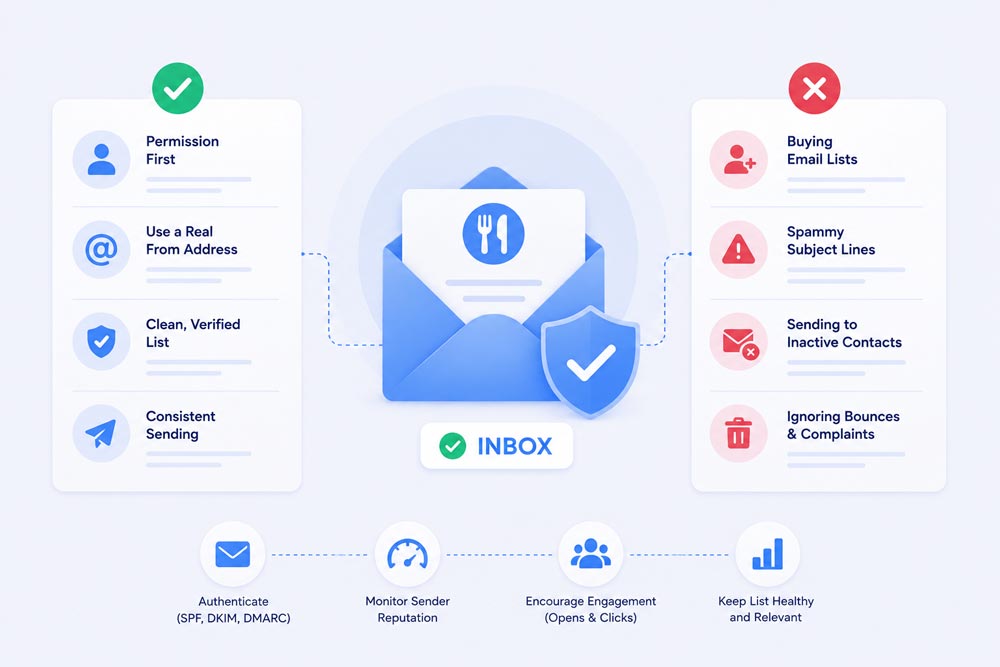
An email that does not reach the inbox earns nothing. Since late 2025, non-compliant mail to major providers is increasingly rejected outright rather than quietly filed into spam, which means the failure is now total rather than partial.
SPF, DKIM and DMARC are three DNS records that tell Gmail and Yahoo your restaurant’s emails are genuinely from your restaurant.
This section is the clearest differentiator in this article, and that is a strange thing to be true. No major restaurant email guide covers sender authentication meaningfully, despite it being the thing most likely to silently destroy a program that is otherwise built correctly.
You do not need to configure any of this yourself. The goal is that you know what to ask your web developer or your platform’s support team for, and that you know it is not optional.
SPF names which servers are allowed to send email on your restaurant’s behalf. DKIM signs each message so the receiving provider can confirm it was not altered in transit. DMARC tells the receiving provider what to do when the first two do not line up.
The requirement most commonly failed is alignment, and it is worth understanding because it is counterintuitive. Authenticating is not the same as aligning. A restaurant sending through a marketing platform under its own domain can pass SPF and DKIM checks and still fail DMARC, because the domain in the visible “from” address does not match the domain that was authenticated.
There is also a simpler and very common failure, which is sending from a Gmail or Yahoo address rather than your own domain. This is still widespread among independent restaurants and it is one of the highest-impact fixes available. Send from your own domain.
Treat authentication as infrastructure rather than best practice. DMARC’s status was elevated from an informational specification toward a formal standard, which is the clearest signal available that this has moved from optional to expected.
Bulk-sender requirements apply at roughly 5,000 messages a day to a single provider. Most restaurants sit comfortably below that on a normal month, and crossing it once applies the rules from then on.
Here is the scenario this section exists for. A restaurant with a 6,000-person list sends one New Year’s Eve announcement. Enough of that list is on Gmail to cross the threshold in a single afternoon. From that point the restaurant is treated as a bulk sender, without ever being notified, and the next few months of deliverability decline look like bad luck.
The practical instruction is simple: configure as though you are already a bulk sender. The requirements are worth meeting at any volume, and retrofitting them after a deliverability collapse is far more painful than doing them in an afternoon now.
Watch your complaint rate as a standing metric. There is a level you should manage against day to day and a higher level at which real damage begins, and the gap between them is your warning zone. Recovery is slow, because reputation is measured over weeks of sending history rather than over a single campaign.
One-click unsubscribe is a technical header requirement, not a visible link in your footer. Most reputable platforms implement it automatically and some do not, which makes it worth verifying rather than assuming. It is specified in the one-click unsubscribe standard if your developer wants the primary source.
Making it easy to leave protects the people who stay. A guest who cannot find the unsubscribe link marks the message as spam instead, and a spam complaint damages sender reputation for every remaining subscriber on your list. The unsubscribe is a pressure valve.
Run a sunset policy. Contacts who have not opened anything in six to twelve months should be suppressed. The result is counterintuitive but consistent: a smaller engaged list reaches the inbox more reliably than a large indifferent one, and total revenue frequently goes up after you cut the list down.
CAN-SPAM in operator terms means identify yourself accurately, do not write misleading subject lines, include a valid physical postal address, and honor opt-outs promptly. Read CAN-SPAM requirements at the FTC directly rather than relying on a summary.
One note if you are running text alongside email. SMS marketing operates under a separate and considerably stricter consent regime. Do not assume email consent covers it.
Across hospitality accounts, the constraint is almost never creative. It is the connection between guest data and the email tool. Most of the first month of any engagement is plumbing, meaning finding where guest records are actually created, getting authentication configured, and connecting the reservation system or POS to the platform. Nothing gets sent during that period, which is not what most clients expect at the start.
Food and hospitality is UADV’s lead vertical, the agency is a Forbes Agency Council member, and founder Alex Quin has covered restaurant marketing strategy in depth on the Hustle Inspires Hustle podcast. On platform selection specifically, we sell no email software and take no vendor commissions, which is why the section above can recommend keeping the tool you already have.
The pattern we see most often on a new hospitality account is a healthy-looking list of several thousand contacts with no visit data attached to any of them, sitting in a platform with no connection to the POS. The list is not the problem. The disconnection is.
If you have reached the point of evaluating outside help rather than building this yourself, choosing a restaurant marketing agency covers what to ask.
Open rate stopped being a reliable metric once Apple Mail Privacy Protection began pre-loading images, and any restaurant still optimizing against it is steering by a broken instrument.
Four numbers replace it. Click-to-visit rate connects email to what happens on your floor. Revenue per send makes email comparable to every other channel you spend on. Repeat visit rate within 60 days is the only number that reflects whether the program is doing its actual job. List growth net of unsubscribes tells you whether the asset is compounding or quietly shrinking.
For anything you want to claim as incremental, use a holdout group. Withhold the campaign from a small random slice of the segment, compare visit rates across the two groups, and the difference is your real lift. It is the only honest way to separate revenue email created from visits that would have happened regardless.
Report monthly, in covers and revenue rather than in engagement percentages. That is the language the owner is already thinking in, and it is the language that keeps email funded.
Weeks 1 to 3, audit and connect. Establish where guest data is actually created, get SPF, DKIM and DMARC configured, and connect the POS or reservation system to the email platform. Nothing is sent during this phase. It is worth saying that plainly, because it also explains why most DIY attempts stall, since this stretch has no visible output and it is where enthusiasm runs out.
Weeks 4 to 6, build the two highest-return sequences. Win-back first, then welcome. The win-back comes first because it monetizes guests you already have, which means it produces revenue while the rest of the build is still in progress.
Weeks 7 to 12, complete the system. Add the post-visit and birthday sequences, establish the broadcast calendar, and start measuring against a holdout group.
Be realistic about the curve. Meaningful compounding shows up in months three to six, not in week two. Anyone promising otherwise is selling something.
A capable in-house marketing coordinator can execute this entire plan without an agency, and this article contains enough detail to do it. If that describes your situation, take it and run.
Every other channel you use is rented. Social reach can be throttled by a change you will not be told about. Marketplace fees rise. Ad costs climb every year and stop working the day you stop paying. Your guest list is the one asset that appreciates and cannot be taken away from you.
Which is why email marketing for restaurants is better understood as infrastructure than as a campaign. It is not something you run occasionally when covers are soft. It is something you build once, correctly, and then let run.
The build order, compactly: work out what your list is worth, capture guests in the places they already are, build the four sequences before you add another broadcast, choose the platform your stack points to rather than the one with the best feature chart, and get authentication right before scale makes it urgent.
In summary, restaurant email marketing works when it is triggered by guest behavior, connected to the systems that hold that behavior, and measured in covers rather than opens.
If you want someone to look at your existing guest data and email setup before you build, book a strategy session with UADV and we will audit what you have and tell you what is actually disconnected. If you would rather start on your own, our guide to marketing your restaurant online is the lower-commitment starting point, and restaurant SEO covers the channel that fills the top of this funnel.
The restaurants that win at email are rarely the ones with the best copy. They are the ones that connected the reservation system to the email tool eighteen months ago and let the sequences run ever since. It is unglamorous, and it is the whole game.
Does email marketing actually work for restaurants?
Yes, and it is usually the highest-return channel a restaurant has, because it targets guests who have already proven they will spend money there. The revenue comes from repeat visits rather than new ones, which is why email works best as a retention channel supported by automated sequences. Restaurants that treat it as an occasional blast to an unsegmented list see very little return, and that is the more common outcome.
How often should a restaurant send marketing emails?
Two to four broadcast emails a month suits most independent restaurants, with automated sequences firing on top of that and not counting toward the total. The right number depends on how often guests naturally visit, so a fast-casual spot can send more than a special-occasion restaurant. Increase frequency gradually and watch the unsubscribe and complaint rates rather than committing to a fixed cadence.
What is the best email marketing platform for restaurants?
There is no single best platform, because the right choice depends on where your guest data already lives. If most covers come through reservations, choose a tool that reads your reservation system; if walk-ins dominate, choose one that reads your POS. A platform that cannot pull guest behavior automatically cannot run triggered sequences, and that single test narrows the shortlist faster than any feature comparison.
How do restaurants collect email addresses without annoying guests?
The highest-yield capture points are ones the guest is already using, meaning reservation bookings, direct online ordering, guest Wi-Fi sign-on and emailed digital receipts. These collect contacts passively without asking a server to do anything extra during service. Active capture through table QR codes works too, but only when it offers something specific like a birthday club or early event access rather than a generic newsletter signup.
What should a restaurant email subject line say?
Be specific rather than clever. A subject line naming the dish, the night and the price consistently outperforms a curiosity hook, because guests scanning an inbox are deciding whether the email is relevant, not whether it is entertaining. Keep it short enough to survive mobile truncation and treat the preview text as a second headline rather than wasted space.
Do restaurants need SPF, DKIM and DMARC set up for email marketing?
Yes. These are DNS records that prove your emails genuinely come from your restaurant, and major providers now reject non-compliant mail outright rather than sending it to spam. Bulk-sender rules formally apply above roughly 5,000 messages a day to a single provider, but one large holiday blast can cross that threshold permanently. Your email platform or web developer can configure all three, and it is worth doing before you scale.
How does UADV approach restaurant email marketing differently?
UADV sells no email software, which means platform recommendations are based on the restaurant’s existing POS and reservation stack rather than on what the agency has to sell. Food and hospitality is the agency’s lead vertical, and most engagements begin with connecting guest data to the email tool before a single campaign is written. Programs are measured in covers and revenue per send rather than open rates.
.webp)
Our team will compare you to your biggest competitors in your industry across multiple points from SEO to social media so you can find strengths & weaknesses in your business.


