
Imagine owning a channel where 98% of your messages are opened, and the response comes within seconds. That’s not a pipe dream; it’s what SMS marketing delivers. Studies consistently show that consumers open almost every text they receive and respond within 90 seconds. Unlike sinking email open rates or unreliable social media, SMS campaigns provide high engagement on a device checked over 100 times daily. It’s no wonder brands earn between $21 and $71 for every dollar spent on mobile marketing.
Despite these impressive stats, many businesses either send generic messages or avoid text message marketing altogether. This guide will show you how to leverage SMS as a high‑ROI channel with effective strategies, SMS marketing conversion rates, and measurable success. Learn how to build a compliant SMS subscriber list, create revenue-driving messages, and track SMS ROI metrics to turn notifications into predictable revenue. Ready to capitalize on SMS? Let’s dive in.
SMS stands for Short Message Service, a 160‑character text protocol supported by nearly every mobile phone. MMS marketing (Multimedia Messaging Service) allows longer messages with images, GIFs, or video, and that’s where MMS marketing becomes useful for product visuals, cart reminders, and launches. Unlike social media or paid ads, SMS is an owned channel: you control the audience, and there are no algorithms gating your reach. Because regulations require customers to give explicit permission before receiving marketing texts, your SMS subscriber list tends to stay higher intent than most channels. For baseline adoption trends and device usage, see Pew Research’s mobile fact sheet.
There are two main message categories:
To keep your program scalable, treat consent and list growth as a system, not a one-time tactic. Your SMS opt-in strategies should make the value obvious, set frequency expectations, and capture consent cleanly, so you can send promotional SMS messages and transactional SMS without risking deliverability.
If you’ve relied on email newsletters and social media posts, you might wonder why you need another channel. Here’s how they compare:
Texts arrive instantly on the most personal device people own, so they cut through the clutter in ways other channels cannot. That doesn’t mean you abandon email or social media – instead, integrate them.
To see how your mix should work in practice, treat this as your SMS vs email marketing comparison rule of thumb: email nurtures, SMS activates. If you want a stronger email foundation to pair with SMS, use UADV’s email marketing best practices as the playbook for SMS segmentation, sequences and testing.
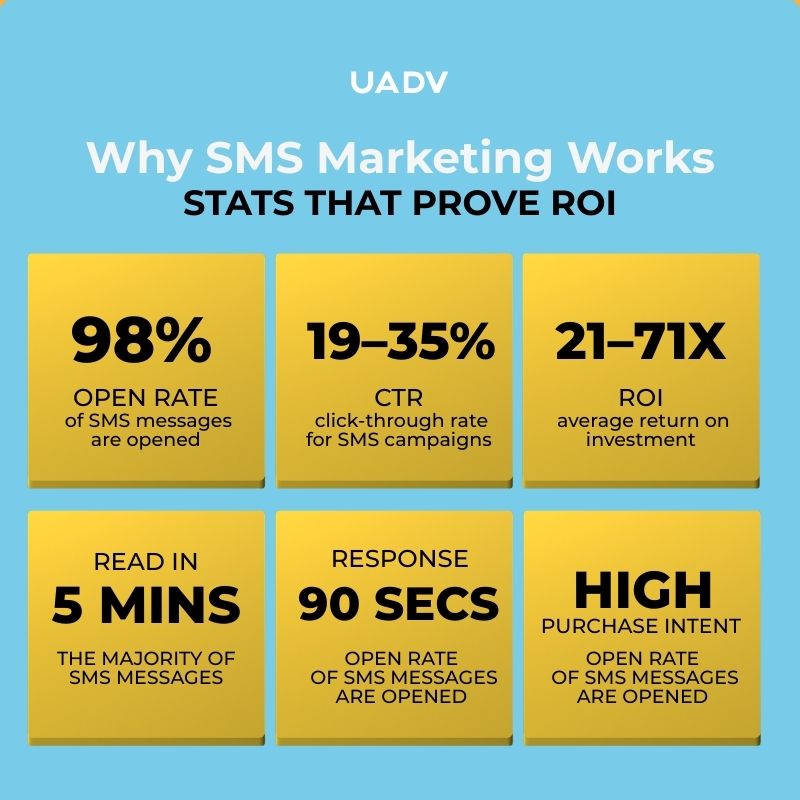
Numbers make the case better than hype. Consider the following:
On the customer side, commerce is mobile. If you sell online, anchor your planning around SMS marketing for e-commerce and modern buying behavior using Shopify’s e-commerce resources and consumer trend research, you can pull as needed via Nielsen Insights.
This is where teams stop guessing and start allocating budget with intent:
Successful mobile marketing goes beyond just sending messages. It’s about building a scalable system that drives consistent revenue without exhausting your subscriber list. UADV’s framework rests on three pillars: list growth, compliance, and engagement. Start by defining clear goals (e.g., 15 % increase in SMS‑attributed revenue in Q2), then map your audience segments and build campaigns around them.
What gets measured gets managed. At a minimum, track the following metrics:
Calculate ROI as (revenue – campaign cost) ÷ campaign cost × 100. Because each text costs pennies, even small sales can yield triple‑digit returns. UADV recommends building dashboards that segment performance by campaign type and customer cohort to identify what drives growth.
Sending the same offer to everyone is a fast way to get ignored. Consumers expect personalization; 74% of them say generic blasts drive them away. The solution is SMS segmentation:
Personalized SMS campaigns generate 35% higher SMS engagement rates than generic messages and convert more carts. Use dynamic lists that update automatically based on customer actions, and integrate your SMS automation tool with your CRM and ecommerce platform so data flows both ways. UADV’s clients often see segmentation improvements translate directly into revenue growth.
Text marketing is powerful because it’s tightly regulated. The Telephone Consumer Protection Act (TCPA) requires prior express written consent before you send marketing texts, and violations can cost $500–$1,500 per text. For the baseline rules, use the FCC’s TCPA overview.
To stay compliant:
For international compliance, follow GDPR in the EU and CASL in Canada, and refer to ICO guidance.
The Telephone Consumer Protection Act (TCPA) governs commercial text messaging in the U.S. It requires businesses to obtain prior express written consent from consumers before sending marketing texts. The key to SMS compliance (TCPA) is ensuring that consent is given clearly and voluntarily.
To comply with TCPA regulations:
Avoid sending SHAFT content (Sex, Hate, Alcohol, Firearms, Tobacco) and respect quiet hours. For international compliance, refer to GDPR in the EU and CASL in Canada.
Collecting compliant opt-ins is essential for SMS marketing success. You must only message customers who have explicitly opted in, with proper disclosures.
To gather opt-ins:
Ensure opt-ins are not pre-checked and that customers cannot complete a purchase without agreeing to SMS opt-in. Do not purchase phone numbers; this is illegal and violates SMS marketing compliance requirements.
Opt-out requests must be honoured immediately, as it’s both a legal requirement and best practice. Complying with opt-out requests promptly reduces spam complaints and enhances your brand’s reputation.
Key points for opt-out management:
Ensure you include "Reply STOP to opt-out" in every message or at least in monthly messages to maintain SMS compliance and respect for customers' preferences.
Your list is your most valuable owned asset, but building it takes work. A healthy SMS program sees 15–25% monthly growth in the early stages and slows as it matures. Prioritise quality over quantity: 1,000 engaged subscribers are worth more than 10,000 inactive numbers. These are proven SMS list-building strategies:
Remember to synchronise your messaging across channels: highlight SMS exclusives in your emails and posts. UADV often pairs list‑building campaigns with educational content; for example, linking to our article on abandoned cart email best practices when encouraging email subscribers to try cart recovery via SMS.
You can’t run a modern program from your phone. Look for a dedicated platform that offers:
Many platforms exist; choose one that fits your business size and tech stack. Whatever you choose, test the platform thoroughly during trials. Migrating later is painful. If you need a practical reference point for text marketing strategy and setup, use Twilio’s SMS marketing starter guide as a baseline checklist.
SMS automation is the secret to scaling without sacrificing personalization. Automated flows account for 18% of SMS‑driven orders from only 9% of sends. High‑impact workflows include:

While SMS marketing fundamentals are universal, each industry has unique applications. For example, e-commerce uses SMS for cart recovery and updates, while restaurants send reservation confirmations and promotions. Real estate agents use SMS for property alerts, and healthcare facilities send appointment reminders.
Small businesses use SMS for bookings, offers, and feedback. Regulations and customer expectations will shape the frequency and content of messages in each industry.
At UADV, we leverage our experience across industries to create SMS campaigns tailored to your business, ensuring compliance and driving results. Let us help you adapt proven strategies to meet your needs.
Two‑thirds of online retailers already use SMS. They send back‑in‑stock alerts, product drops, VIP early access, and loyalty perks. Combining promotions with transactional SMS like shipping updates, builds trust and drives 10–20% of total revenue for mature programs. For deeper email strategies, see UADV’s post on email marketing best practices.
Restaurants use SMS to fill seats and build loyalty. Reservation confirmations, waitlist notifications (“Your table is ready”), daily specials, and event invites work well. Location‑based offers (e.g., lunchtime discounts within 2 km) can increase foot traffic. Hospitality brands adopting SMS see patrons visit 20% more frequently and spend 23% more per visit. For more restaurant marketing tips, read our restaurant marketing guide.
Agents and service providers thrive on timely communication. Use SMS for new listing alerts, open house reminders, appointment confirmations, and status updates. Seventy‑two per cent of homebuyers prefer texting with their agent. Appointment‑based businesses like salons, dentists, and auto repair shops reduce no‑shows by 80% by sending reminder texts.
For appointment‑based services like salons, dentists, and auto repair shops, SMS is a lifeline. Appointment reminders cut no‑shows by 80%, and follow‑up messages drive reviews and referrals. Seasonal promotions keep your business top of mind. Because budgets are limited, the high ROI of text marketing makes it a perfect fit. UADV’s article on in‑house marketing vs. agency can help you decide whether to manage SMS yourself or partner with experts.
Once your campaigns are running, make continuous improvement part of your process:
Steer clear of these pitfalls:
Avoid these mistakes, and you’ll build trust, maintain a healthy list, and drive sustainable results.
Text message marketing delivers proven results with high engagement, rapid response times, and exceptional ROI. When executed strategically, it can account for 10–20% of total revenue.
The formula is simple: build a compliant opt‑in process, segment your audience, send personalised messages at the right times, automate high‑impact workflows, test and measure relentlessly, and respect your subscribers. Start small with a welcome series and cart recovery flow, then expand into promotions, two‑way SMS, and loyalty programmes.
Within weeks, you’ll see results; within months, SMS can become one of your most profitable channels.
Why continue wasting more time and money on marketing strategies that don't work? Your business deserves better marketing. Say goodbye to empty promises and half-ass results; UADV is the only full-service marketing agency that grows your business (no excuses). Get a free consultation with our expert team now!
SMS marketing involves sending promotional or transactional messages to customers who have explicitly opted in. Businesses collect phone numbers through compliant forms or keyword sign-ups, then use an SMS platform to send and automate campaigns. Messages are sent instantly to customers’ phones with personalized content, links, and discounts.
SMS platform fees typically range from $39–$500+ per month, with additional costs of $0.01–$0.03 per SMS and $0.03–$0.08 per MMS. Additional charges for short codes and features may apply. Despite being costlier than email, SMS offers a higher ROI, often generating $21–$71 for every $1 spent on campaigns.
SMS open rates are typically around 98%, far exceeding email’s 20–26%. While open rates are important, SMS engagement rates such as click-through and conversion rates provide better insights into performance. Focus on tracking these engagement metrics to measure the actual impact of your campaigns beyond just opens.
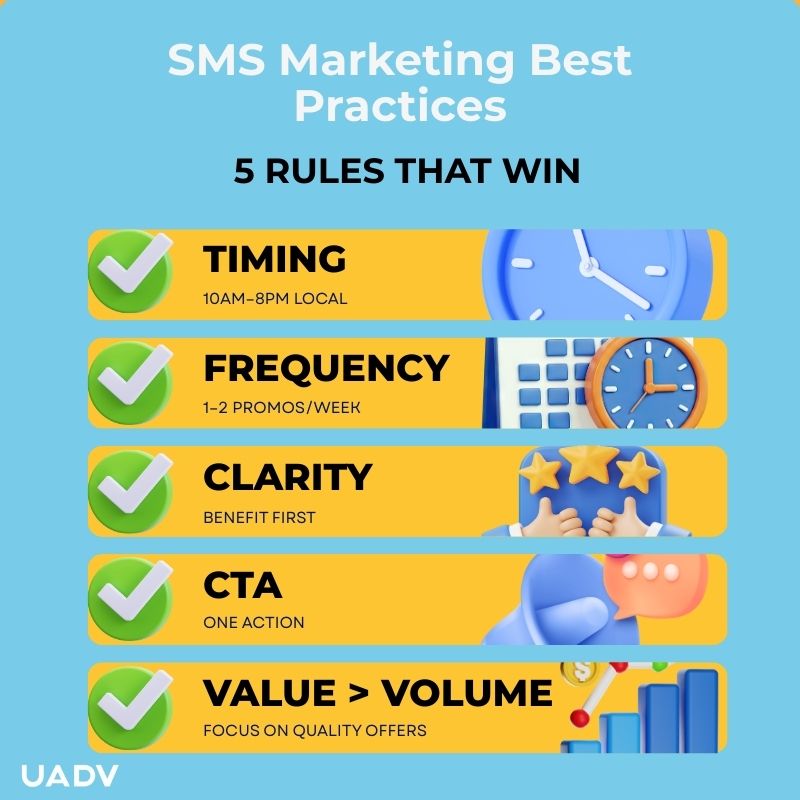
It’s best to send 1–2 promotional SMS messages per week. Transactional messages, such as order updates, don't count toward this limit. Set clear expectations during opt-in and honor them. During major sales, it’s acceptable to increase frequency but avoid overwhelming subscribers with excessive messaging to maintain trust.
Yes, SMS marketing is legal when done with proper consent. You must obtain explicit written consent, provide necessary disclosures, respect quiet hours (no messages before 8 a.m. or after 9 p.m.), and honor opt-out requests. Violations can result in fines between $500 and $1,500 per text message.
Grow your SMS subscriber list using website opt-in forms, email-to-SMS migration, social media promotions, QR codes, and referral programs. Offer compelling incentives such as discounts or VIP access. Always ensure your opt-in language is clear and complies with SMS opt-in strategies to maintain a compliant and engaged list.
.webp)
Our team will compare you to your biggest competitors in your industry across multiple points from SEO to social media so you can find strengths & weaknesses in your business.


