
You have a full crew, a five-star reputation, and a card on file with a lead marketplace that charges you every time a homeowner fills out a form. Stop the card, and the phone stops. That is renting demand, and most contractors have done it so long they no longer notice it is a rental.
SEO for home services is how you stop renting. And yes, it works for contractors, just not on the timeline or in the order most people expect. Getting that order right is most of the job.
This guide covers the real economics of owned versus purchased leads, the three signals that decide map pack placement, a service-and-city page structure that scales without tripping Google's thin-content filters, and a phased order of operations. Most guides hand you twenty items with no priority attached. This one is ordered by what pays back first, which is the only order that matters when you run the business and do the marketing. It comes from UADV, an agency that runs local search for service and hospitality businesses across South Florida.
The choice was never SEO versus doing nothing. It is paid lead marketplaces versus search visibility you own, and the costs behave completely differently over time. The difference between buying leads and earning them is that one resets to zero every month, and the other compounds.
Be honest about the tradeoff, because you have probably been oversold before. Marketplaces deliver volume immediately, and SEO does not. What they cannot do is leave you anything at the end of the year. Three questions settle it using your own numbers, in about fifteen minutes.
Shared leads on the major marketplaces are sold to several contractors at once, so the effective cost is never the sticker price. It is the sticker price divided by your close rate. Sold to three competitors alongside you, that lead closes at a fraction of the rate it would on an inbound call where you are the only company on the line. Divide the lead price by that close rate, and you have cost per booked job, the only figure that touches your bottom line.
You are dealing with three pricing models, and they behave differently:
The deeper problem underneath all three is identical, and it is the part that stings. You never own the customer relationship, and you never own the visibility. Check any cost-per-lead figure against current platform documentation before relying on it, because this category changes quarterly.
A page that ranks keeps producing calls long after the work that created it is finished. A paid lead is consumed the moment it arrives.
The compounding is mechanical. Reviews pile up, directory listings age into trust, city pages pick up links, and the profile gets stronger with time instead of weaker. That is an asset you own rather than an expense that repeats every month.
The honest counterpoint, before you raise it: compounding assumes maintenance. An abandoned Google Business Profile and stale service pages decay, faster in a competitive metro than in a rural county.
There is also an exit angle contractor marketing rarely mentions. You cannot sell a marketplace account. A service business with strong search visibility in its metro is worth more when you sell it, because the buyer is purchasing a pipeline rather than a subscription.
Run the numbers in three steps: average job value, close rate on inbound calls, and current cost per booked job through purchased leads.
Multiply average job value by gross margin for the profit on a typical job. Divide monthly lead spend by the jobs those leads actually produced for your real cost per booked job. Whatever search has to beat is now a figure rather than a feeling.
High-ticket trades hit break-even faster, and the ad auction reflects it. One won HVAC install or roof replacement covers months of investment, which is why clicks in those categories cost what they do.
Now, the part most agencies will not say out loud. Some businesses should not start here. With no reviews, no consistent scheduling, and nobody reliably answering the phone, search sends you traffic you cannot convert, and you conclude the channel failed. Fix the operation first.
Every guide has a section like this, so we will be quick and spend the depth where it helps.
The difference between local SEO and traditional SEO is that one competes for a keyword and the other competes for a keyword inside a radius. Home services SEO diverges from standard local SEO in two ways: how Google classifies your business, and how urgently your customer is searching.
A business that travels to customers is classified differently by Google than one customers visit, and that classification decides what appears in search, how your address is handled, and how you declare where you work.
Google's Business Profile documentation is direct. If you do not serve customers at your business address, Google instructs you to remove the address, and notes that hiding it means the profile displays only your service area. Google also caps you at 20 service areas defined by cities, postal codes, or other regions. For the full field-by-field walkthrough, read our guide on how to optimize your Google Business Profile
Here is the mistake that costs rankings most often. Operators declare an enormous service area, hoping for a wider reach, only to dilute their relevance. Google's service area guidance advises that the boundaries "shouldn't be more than about 2 hours of driving time from where your business is based."
Proximity is doing real work. Google's explanation of how Business Profile ranking works names three ingredients: relevance, distance, and prominence, with distance described as "how far each business is from the customer who's searching." You cannot declare your way into a neighboring city's results. If the fundamentals are new to you, our primer on local SEO covers the groundwork this section assumes.
Home services traffic splits into two behaviors that need different pages, and treating them as one audience is why a lot of contractor content underperforms.
Emergency intent looks like a burst pipe at 11pm, an AC that failed on the first ninety-degree day in August, or half a house with no power. These searchers convert in minutes, do not read, and choose on proximity, review count, and whether a human answers.
Planned intent looks like a kitchen remodel or a system upgrade the homeowner has been saving for. These searchers research for weeks, read comparison content, and reward depth and proof.
The practical conclusion writes itself. Emergency intent is won in the map pack and on the phone. Planned intent is won with content and reviews. The same business needs both, and most contractors optimize as though they only have one.
Trades with weather-driven demand carry a seasonal overlay. Publish ahead of the season, not during it. A roofing page that goes live the week after the first named storm is already late.

This is the highest-leverage section here, for a simple reason: in home services, the map pack is where the phone rings. The blue links underneath matter considerably less than most contractors assume.
Here's what most contractors don't realize. Three signal groups carry the majority of local pack ranking weight, and nearly everything else exists to reinforce them: the business profile, the pages behind it, and the review signal.
One note on weighting claims. Whitespark's 2026 Local Search Ranking Factors report surveys 47 practitioners against 187 factors, and its highest-scored local pack factors include primary Google Business Profile category, proximity of address to the point of search, and physical address in the city of search. Treat that as expert consensus rather than a leak of Google's algorithm.
Your profile is the single highest-leverage asset in home services SEO, and most of the ones we audit are roughly sixty percent complete.
The gaps repeat with almost boring consistency:
The category point deserves emphasis. The most specific accurate primary category outperforms a general one, and picking something like "home services" for a business that does one trade well is almost always wrong. Whitespark's 2026 respondents ranked primary category as their top-weighted local pack factor, which matches what we see in audits.
Profile activity is itself a signal. A profile updated monthly outperforms an identical one left static, which is the cheapest recurring win available to you.
The page you need matches a single service in a single city, because that is how homeowners search. Nobody types "plumbing services." They type "water heater replacement Pembroke Pines."
The math gets uncomfortable fast. Multiply services by target cities and you have your page count, and six services across eight cities is forty-eight pages. This is where most contractors either give up or generate templated pages with the city swapped, and the second option is worse.
Service-plus-city pages capture the emergency searcher who wants someone close and available. Deeper service pages, the ones with real explanation and proof, capture the planned-purchase researcher still comparing. We are not resolving the thin-content problem here. That is the next section, and it is the part competing guides skip.
For home services, how recently and how steadily reviews arrive matters more than the raw total.
Velocity is easy to picture. Three or four reviews arriving every month signals an active business doing work right now. Two hundred reviews that all stopped eighteen months ago signals the opposite, and a homeowner reading them can tell.
Response rate and response speed are signals in their own right, and responses that mention the service performed add relevance. Google's ranking explanation notes that more reviews and positive ratings can help local ranking, and homeowners are reading them either way: BrightLocal's 2026 Local Consumer Review Survey reports 97% of consumers read reviews for local businesses, with 41% saying they always do. If you are unsure how to handle the bad ones, we wrote a separate guide on how to respond to negative reviews.
The fix is same-day work. Build the review request into the job-close workflow, so the tech asks before leaving or the office texts within two hours of invoice. Leave it to whoever remembers, and it will not happen.
One firm boundary. Review gating, which means screening out unhappy customers before they can post, and incentivized reviews both violate Google's policies and put your profile at risk. Google's prohibited and restricted content policy states that merchants may not offer incentives such as payment, discounts, or free goods in exchange for a review, and may not discourage negative reviews or selectively solicit positive ones. Asking every customer is fine. Asking only the happy ones is not.

Every competing guide tells you to build city pages. None tell you how to do it without producing forty near-duplicate templates.
The playbook: pick the cities you can actually serve, write the service page first, differentiate every location page with something only a local would know, and stop before you run out of real content.
The governing principle is the one nobody states. Your constraint is not SEO ambition. It is how much genuinely unique material you have for each city. Auto-generated pages with the city swapped are the fastest route to being ignored or filtered. If you would not hand the page to a customer in that city and feel good about it, Google is unlikely to rank it.
South Florida is a textbook case. Hollywood, Fort Lauderdale, Hialeah, and Pembroke Pines sit a short drive from each other, and the differences are real: different housing stock, different construction eras, different problems calling for service.
Build a page for every city where you have completed work and can speak specifically about it. Then stop.
Start with the cities producing revenue today, not the aspirational radius painted on your van. Eleven jobs in Davie last year and zero in Boca Raton means one page, not two.
Fewer strong pages beat many weak ones, and that is more than an efficiency argument. A bloated set of thin location pages can drag on the pages that were working, because you watered down the site's overall quality to avoid the work of writing. The honest answer to "how many" depends on evidence of local presence, and ten strong location pages consistently outperform forty templated ones.
Swap the city name and change nothing else, and the page is worthless. The uniqueness has to be substantive.
The differentiating material is already sitting in your business:
The South Florida illustration shows how concrete this gets. Service calls in older Hollywood housing stock, with its aging plumbing runs and original electrical, differ meaningfully from newer Pembroke Pines construction where problems skew toward builder-grade fixtures and HVAC sizing. A page that reflects that reads as real because it is.
Photographs from actual jobs in that city carry weight stock imagery cannot. A picture of your truck outside a house on a street a local recognizes beats a stock photo of a smiling technician.
None of this is quick, and that is the point. You are deciding whether you can execute it yourself, and honest difficulty is more useful than encouragement.
You have heard the panic version already. Here is the calm one.
Generative engine optimization means structuring content so an AI system can quote it confidently, which turns out to look a lot like structuring content well in the first place.
Homeowners increasingly get a shortlist from an AI answer before they see a page of blue links, which moves the goal from ranking to being the source that gets cited. Home services is comparatively well-positioned. Assistants favor businesses with consistent information across platforms, and the listings, profile, and review work described above is exactly what builds that consistency.
Pose the question as a heading and answer it immediately underneath in roughly forty to sixty words, then add the context.
The format works for Google's featured snippets and for AI answers at the same time, which means one writing habit serves two channels. You are not doing separate work for each.
The questions worth answering this way are trade-specific and predictable: what a water heater replacement costs in your area, how long a roof replacement takes, the warning signs that an AC needs replacing rather than repairing, and whether a fifteen-year-old system is worth fixing.
Unique information wins the citation. Pricing you have observed locally, or a problem common to a specific regional housing stock, gives an assistant a reason to cite you over the twenty pages saying the same generic thing.
Structured data does not improve rankings on its own. It removes ambiguity about what your business does, where it operates, and what it offers.
Google is explicit about the boundary. Its structured data guidelines state that "using structured data enables a feature to be present, it does not guarantee that it will be present," and its introduction to structured data frames the benefit as helping Google understand page content and qualifying pages for rich results.
The markup types that matter here are few. LocalBusiness structured data describes the business itself, which schema.org defines as "a particular physical business or branch of an organization." Service describes what you offer. FAQ markup fits pages built around common questions. You do not need a schema education beyond that.
The realistic task is checking, not coding. Most modern site platforms produce a usable baseline automatically, so the job is confirming that what they output is accurate. That should save you money.
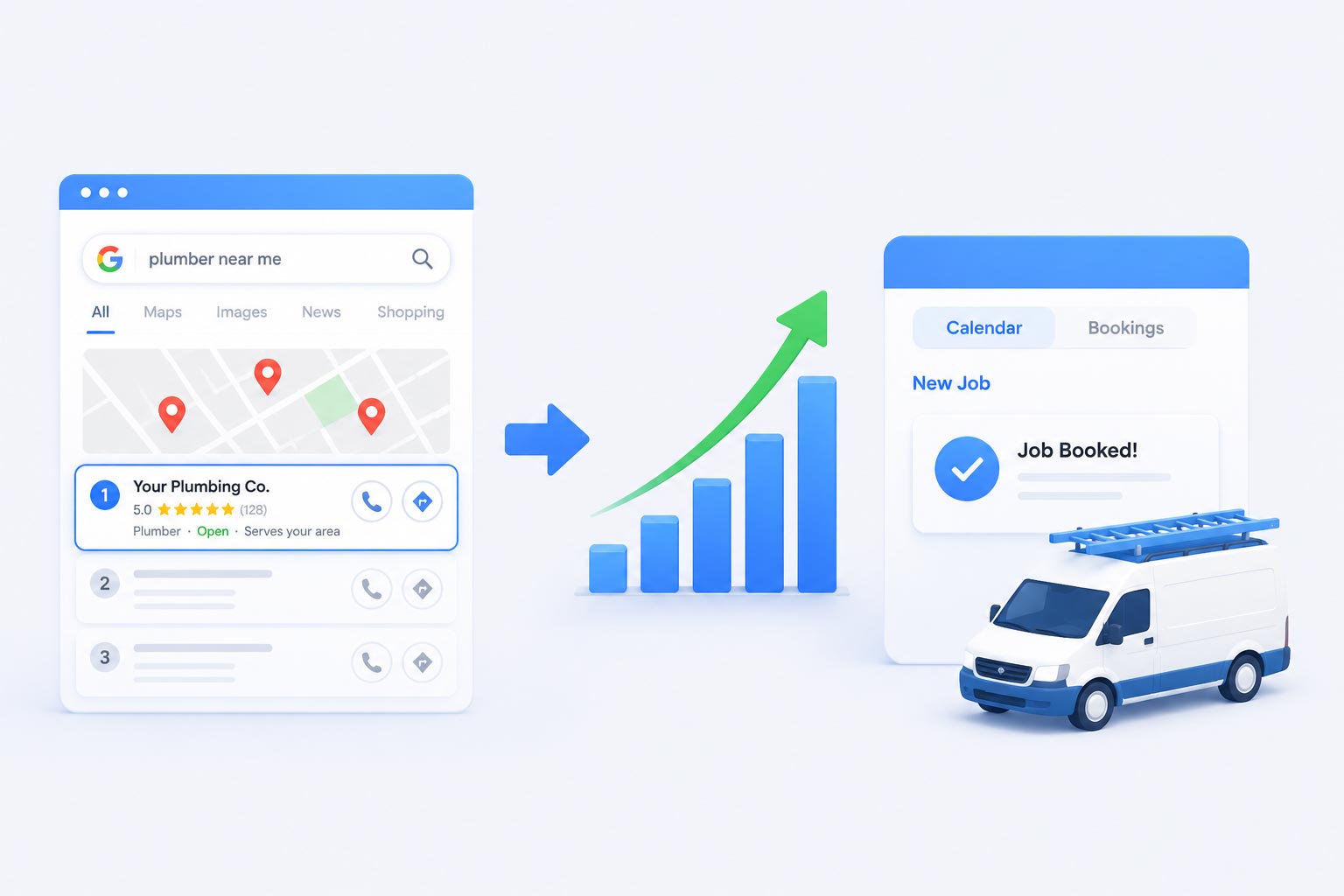
Plenty of contractors reach page one and see no revenue change. The gap is almost always conversion, not visibility. The short answer is that rankings produce calls, and calls produce revenue only if someone picks up.
Competing guides largely stop at visibility. What follows is workflow advice rather than marketing advice, and the distinction matters to anyone who has run a crew. When UADV audits inbound call handling for service clients, the pattern is boringly consistent: the marketing is rarely the weakest link.
For emergency intent, the contractor who answers first usually wins the job regardless of who ranked first.
Picture the behavior honestly. A homeowner standing in water calls down the list until somebody answers. Every unanswered call hands the job to the next result, and the ranking you worked for makes money for your competitor.
The fixes are unglamorous:
Without call tracking and a consistent question at intake, you cannot tell which channel produced which job, and you cannot make an informed budget decision next quarter.
The minimum setup is smaller than you think. A tracking number on the site, a dynamic number for paid traffic, and one scripted question at intake logged in the same place every time. Skip the full analytics build. You will not maintain it.
One trap to avoid. Tracking numbers scattered carelessly across directories create exactly the inconsistent business information your listings work was meant to eliminate. Keep your primary number consistent everywhere it is publicly listed, and confine tracking numbers to controlled placements.
That closes the loop this article opened. The break-even calculation from the first section only produces a real answer if you are measuring, so tracking is the input, not a nice-to-have.
Fix what is broken, build what compounds, then scale what is working, in that order. Phases beat calendar months, because a competitive metro moves slower than a rural county, and a fixed timeline would be wrong for half of you.
Set expectations honestly. Meaningful movement typically takes several months, competitive metros take longer, and any provider promising page one in thirty days is selling something they cannot deliver. We break the timeline down further in how long it takes for SEO to work. This work rewards consistency far more than intensity.
Here's what most people don't realize. The damage usually comes from something that was set up wrong once, not from something missing.
You have just read that agency guides on this topic are usually sales documents, so here is a description of method rather than a pitch.
At UADV, home services work starts with an audit of what the business already ranks for, because the fastest wins usually sit in positions four through fifteen. Pages that almost rank need editing, not replacing, and that produces movement in weeks rather than quarters.
We are headquartered in Hollywood, Florida, working with local service and hospitality businesses across Fort Lauderdale, Miami, Hialeah, and Pembroke Pines. That is the adjacent-city targeting problem described earlier, and it is why the city page discipline here reads the way it does. Vertical siblings like our work on local SEO in a specific vertical, SEO for another service-based vertical, and digital marketing for plumbers run on the same playbook, and we keep generic framing in SEO for small businesses more broadly where it belongs. Trades on the build side are covered by our construction marketing agency work.
On credentials, briefly: UADV is a member of the Forbes Agency Council, and founder Alex Quin writes on marketing for Forbes and Entrepreneur.
We will also be straight about where the depth comes from. Our lead vertical is food and hospitality. The mechanics that make a restaurant findable in Hollywood are the same ones that make a plumber findable there: profile accuracy, review velocity, proximity, and pages matching how people search. That transfer is real, and more honest than claiming a decade of specialization we do not have.
What we bring to SEO for home services is sequencing, which is what this entire article has argued matters.
You opened this article renting your lead flow. You now have a way to evaluate whether owning it is worth it for your numbers, which was the only honest thing this piece could give you. For the broader case, we cover why SEO matters for local businesses separately.
Investing in SEO for home services is slower than buying leads, and it is the only form of demand generation that continues after spending stops. That is the whole trade.
The contractors who win local search are rarely the ones doing the most. They are the ones doing the right things in the right order: profile and reviews first, service and city pages second, expansion third.
As AI assistants mediate more of how homeowners choose contractors, the businesses with consistent, verifiable, locally specific presence get recommended. That raises the return on this work rather than lowering it, which is the opposite of what most operators assume about AI search.
If you want the audit and the sequenced plan for your market, book a strategy session with UADV. You will get the pages already close to ranking, the profile gaps costing you map pack placement, and the phased order to work through them. Our Miami SEO company page shows who you would be working with.
SEO for home service businesses works especially well because the competition is geographic rather than national. A plumber in Fort Lauderdale only needs to outrank other plumbers serving Fort Lauderdale, a far smaller field. The tradeoff is time, since paid leads arrive tomorrow while search visibility takes months and then keeps producing.
Pricing varies by market competitiveness, how many services and cities you target, and how much foundational work the business needs first. The more useful question is what it costs relative to what you currently pay per booked job through the lead marketplaces. Run that comparison before requesting a single quote.
Most home service businesses see initial movement within a few months, with meaningful lead volume taking longer in competitive metros. Google Business Profile fixes show first because the profile can be corrected immediately, while service and city pages need time to be crawled, indexed, and trusted. Thirty-day promises are unrealistic.
Build a page for every city where you have completed real work and can write something genuinely specific, then stop. There is no correct number, because the limit is how much unique material exists rather than how many cities sit on your map. Ten strong pages beat forty templated ones.
They solve different problems, and most established contractors run both. Local Services Ads deliver leads immediately at a per-lead cost that never stops, while SEO builds visibility you own but takes months. The common sequence is paid for cash flow, organic for the foundation, then reducing paid dependence over time.
Setting the service area far wider than the business realistically serves, hoping to appear in more places. It backfires because distance from the searcher is one of the three factors Google names, so an inflated radius dilutes relevance rather than expanding reach. The second is never touching the profile after setup.
Yes. UADV is a digital marketing agency headquartered in Hollywood, Florida, working with local service and hospitality businesses across Fort Lauderdale, Miami, Hialeah, and Pembroke Pines. Our approach to SEO for home services starts with an audit of existing visibility, because the fastest wins already rank just outside striking distance.
.webp)
Our team will compare you to your biggest competitors in your industry across multiple points from SEO to social media so you can find strengths & weaknesses in your business.


