
Ask a roomful of contractors whether anyone is actually making money with Google Ads, and watch what happens. A few nod. Most look at the floor.
The ones looking at the floor are not wrong. They were just never shown the math. PPC for home services works when the math works, and most contractors have never run it. This is an arithmetic problem before it is a marketing problem.
Here is the range that sets the stakes. In LocaliQ's 2025 search advertising benchmarks for home services, drawn from 3,211 US campaigns, median cost per click ran from $5.75 for garage services up to $12.18 for electricians, with an overall home services median of $7.85 per click and $90.92 per lead. Roofing leads in that same dataset cost $228.15. One vertical, a five-fold spread.
You will get what it costs by trade, a workable budget floor, the three ways to buy a lead on Google, what the August 2026 Local Services Ads migration changes in your account, and why most campaigns fail after the click. That migration is live right now, which is section four.
The short answer is yes, but only above a revenue floor and only when speed to lead is solved first.
PPC for home services is not a growth channel for every contractor. It converts cash into leads at a knowable rate, and the only question is whether your close rate and job value make that trade profitable. Your skepticism is reasonable: the most-read discussion on this topic is a forum thread asking whether any of it is worth it, which tells you the market has been burned. What follows is the math to run first, and the conditions under which the honest answer is no.
Three numbers set the most you can afford to pay for a lead: average job value, gross margin, and close rate on inbound leads.
Work an example. A $4,500 HVAC install at 40% gross margin is $1,800 of gross profit. Close one lead in four, and four leads at $200 each cost you $800 to book that $1,800, before a single maintenance visit or referral.
Close rate swings the answer harder than lead price. A contractor closing 15% and one closing 35% can pay very different prices for the identical lead, and both be right. Improving intake from 15% to 25% does more for your numbers than any bid adjustment your agency makes this quarter.
Lifetime value is the adjustment most contractors skip. Maintenance plans and referrals mean the first job understates what a customer is worth. Run this before you open a Google Ads account.
Paid search is wrong when you cannot fund a 90-day test, when nobody answers the phone within minutes, or when your average job value cannot absorb trade-level lead costs.
Take the budget floor seriously. Automated bidding needs a steady flow of leads to learn from, and how many leads your budget buys depends on cost per lead. At LocaliQ, with a roughly $91 median across home services, 15 to 20 leads a month land near $1,400 to $1,800 in media before management fees. Below that, the system never gets enough data, and you pay learning-phase prices without reaching the payoff.
The second disqualifier is blunter. A business that cannot answer calls during business hours converts paid clicks worse than free ones. Watch the seasonality trap too, because launching an HVAC campaign at the demand trough produces numbers that look like channel failure but are calendar failure. "Not yet" is a legitimate outcome, and nobody will tell you that in a sales call.
The difference between a $6 click and a $12 click is not your agency. It is your trade, your market, and whether the searcher has an emergency.
Blended averages are close to useless, and this is where nearly every competing article stops. A single number covering house cleaning and roof replacement describes neither. If you want the broader picture of what Google Ads cost across industries, we cover that separately. This section stays inside the trades.
Four tiers let you find yourself in two seconds. All figures below are LocaliQ's 2025 home services medians.
Two cautions. LocaliQ notes its averages are technically medians, calculated to reduce the pull of outliers, over a sample running April 2024 to March 2025. WordStream's 2026 benchmarks, built from 13,474 US campaigns running April 2025 through March 2026, put the broader Home & Home Improvement category at $8.33 per click. Two credible sources, two methodologies, two windows. Do not blend them, and pull your own auction insights before assuming a national median describes your zip code.
Reported home services cost per lead spans a very wide range, and the spread is real rather than sloppy reporting.
LocaliQ's 2025 report makes the point: $46.99 for cleaning services, $93.69 for electricians, $129.02 for plumbing, and $228.15 for roofing and gutters. Same dataset, same period, roughly a five-fold difference.
Channel matters as much as trade. Branded search is dramatically cheaper because someone typing your company name has already decided. Local Services Ads generally undercut standard search per lead because you pay for leads rather than clicks, and Performance Max usually lands between them.
Question a benchmark rather than accept one. Ask which channel, which quarter, how many accounts, and whether branded traffic was folded in. Then connect it to break-even: a $228 roofing lead and a $47 cleaning lead can be equally good buys, because the job values are not comparable.
There is no universal floor, and anyone quoting one is guessing. There is a way to work out yours.
Take the median cost per lead for your trade from a dated source, decide how many monthly leads give an automated system something to learn from, and multiply. Most trades land in the low four figures of monthly ad spend before optimization becomes real, with high-ticket trades well above that.
Keep ad spend and management fees separate. Contractors routinely blur the two, then either conclude the channel costs more than it does, or budget for ads and forget the labor.
Then respect the 90-day rule. Month one buys data, month two buys correction, month three is the first honest read. Judging at day 30 is the most common self-inflicted wound here. If you run several service lines, allocate by margin rather than evenly, because the migration changes how multi-service budgets behave.
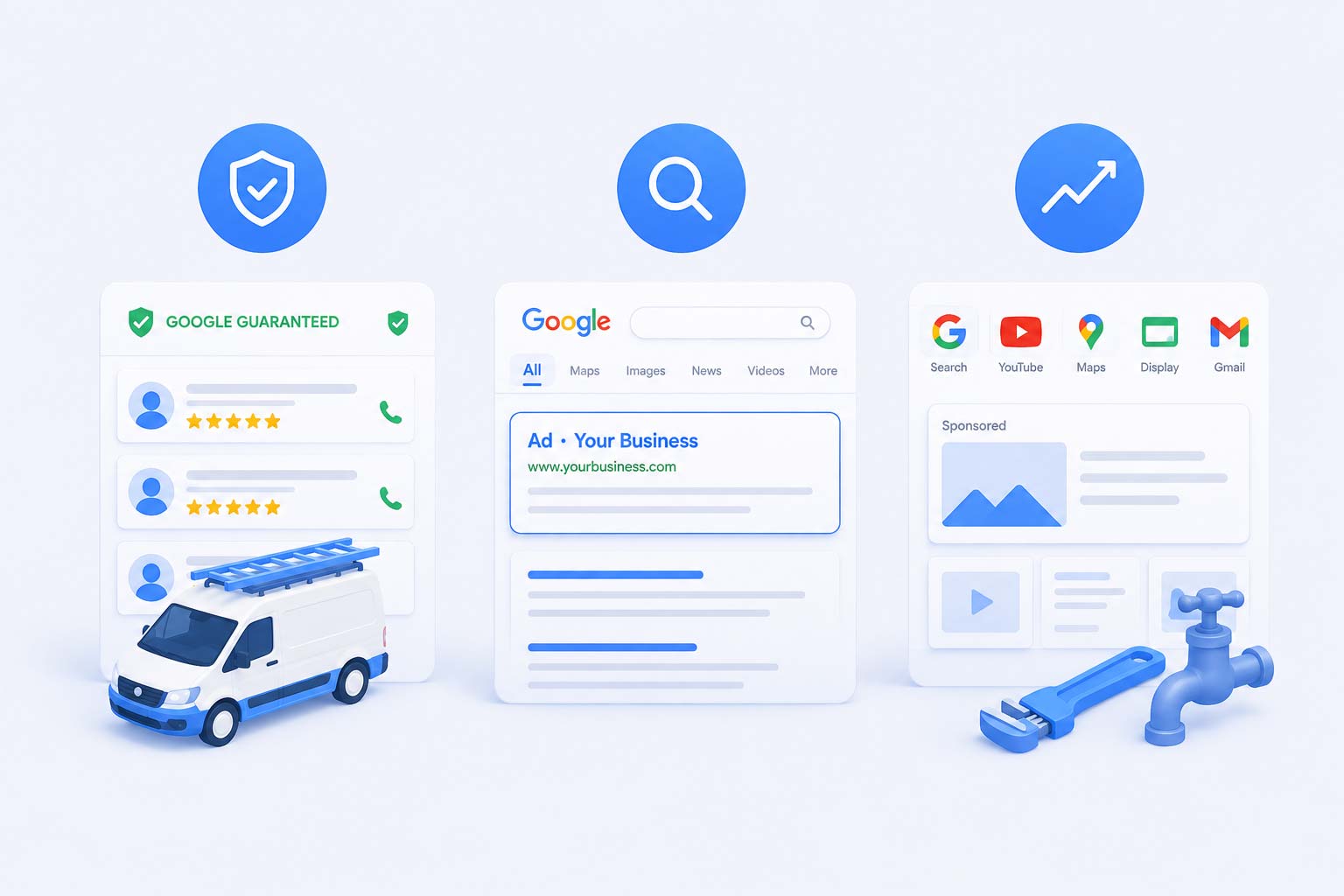
Local Services Ads, standard Search, and Performance Max. Google will sell you the same homeowner three different ways at three different prices. The results page shows the hierarchy before any auction mechanics make sense: Local Services Ads at the top, standard search ads below them, the map pack, and organic results below that.
Treat this as a comparison rather than a ranking. Most home services accounts run a mix, and anyone declaring one format the winner is selling that format. One more thing going in: the boundary between two of these three is actively dissolving.
Local Services Ads charge per lead rather than per click, run without keyword targeting, and require verification checks that earn the badge on the ad.
Google's documentation states that businesses advertising directly with Google "undergo screening procedures that vary by category and region but may include license, insurance, and background checks." Note the naming: current documentation refers to the Google Verified badge, and a Google Screened badge for state-licensed categories. The older Google Guaranteed label still appears in some help content, so expect both terms.
The badge does real commercial work, sitting above every other result where a homeowner deciding whether to let a stranger into their house will weigh it heavily.
Ranking factors are not what contractors expect. Google's page on Local Services ad rankings lists your bid, how likely your ad is to result in a lead, including your responsiveness and profile quality, described as "your rating, number of reviews, average response time, use of high-quality images, the verification checks you have completed." Google adds that higher quality profiles "may rank higher and may also pay lower costs per lead." A business spending less can outrank one spending more.
Reviews now flow through your Business Profile rather than a separate link, which couples the systems tightly. Start with our guide on how to optimize your Google Business Profile. On budget, Google states that invalid or low-quality leads are not charged, and that charged leads get reassessed over time and "may be issued credits automatically if later determined to be low quality," usually within 30 days.
Standard Search is the only format that lets you control exactly which query triggers your ad, which is why it wins on specific, high-margin, non-emergency services.
Picture a specialty install the broad Local Services categories cannot isolate: a ductless mini-split retrofit, a tankless conversion, a commercial certification. Local Services files that under a general category and sends you calls for work you do not want.
Keyword-level control is the actual product you are buying: match types, negatives, ad scheduling, geographic bid adjustments. The tradeoff is honest. More control means more management work, and an unmanaged Search campaign decays faster than an unmanaged Local Services profile because the searches that trigger your ads drift while nobody watches.
Performance Max hands targeting to Google's automation in exchange for less visibility into where the money goes.
Google defines a Performance Max channel as "the surface where an ad was served," listing Google Search, the Display Network, YouTube, Discover, Gmail, Maps, and Search Partners among them. That is a lot of surface area for a campaign type most contractors have never opened.
In published contractor data, Performance Max cost per lead often lands below non-branded Search. Lead quality is the standing debate, and it is real, because cheaper leads that close at half the rate are not cheaper.
Watch one specific problem. Performance Max can absorb searches for your own business name and report them as new leads, flattering the numbers. Google's brand exclusions exist for this, described in its documentation as the most effective way to control how ads appear on searches for your brand. Turn them on before you evaluate performance. Structurally, Performance Max is the infrastructure Google is migrating Local Services Ads onto, which is why it now concerns every home services advertiser.
The short answer is that Local Services Ads are not going away. They are moving. The dashboard is being retired, not the product.
Google's migration documentation states that "existing Local Services Ads campaigns will be automatically migrated to a specialized Performance Max campaign type optimized specifically for pay-per-lead goals." The pay-per-lead model is intact. The control room relocates.
Phase one began in August 2026 for select US home and storefront service advertisers, and Google's documentation names plumbing, HVAC, electrical, appliance repair, house cleaning, lawn care, roofing, pest control, and moving among them. Google has indicated the migration expands in late 2026 to service-area businesses without storefronts and accounts with custom bidding or booking setups, with non-US accounts and remaining categories following in 2027.
Treat those dates as a rough guide. Your operative deadline is the notice sent to your account, and Google describes a 14-day advance email followed by a 7-day reminder.
Lead history, verification status, and the badge transfer. Historical performance reports do not.
Google confirms that past lead history, including contact details, message history, and older call recordings, transfers automatically into the new Lead Manager, along with verification status and badge, targeted locations, service types, categories, budget limits, ad schedule, and photos.
Now, the action item. Google states that "your previous campaign-level performance metrics (such as past impressions, clicks, weekly spend, and ad-level performance reports) will not migrate to Google Ads." Download them before your migration date, or those baselines are gone.
That loss hurts more here than in most industries, because seasonality defines HVAC, roofing, and lawn care advertising, and multi-year baselines are how you decide whether to raise budget in March. Two operational notes: once migrated, the original dashboard becomes inaccessible, and login attempts redirect to Google Ads; your Business Profile now syncs directly into the Local Services profile for name, address, hours, and categories.
Manual cost-per-lead bidding is going away, replaced by automated bidding with one target cost per lead across the whole campaign.
Google is direct: "Manual bidding (such as setting a maximum cost-per-lead) is no longer supported in Google Ads," and Google Ads "does not support vertical-level Target CPA bidding," so "a unified campaign-level Target CPA will be calculated and applied to all vertical categories."
Here is the squeeze. A plumbing company that also sells HVAC could previously target different lead costs per category, which made sense because those categories cost different amounts and produce different job values. One campaign-wide target averages numbers that should not be averaged. The workaround is separating service lines into their own campaigns.
Budget pacing changes too. Google states your historical average weekly budget is divided by seven for a daily average, with monthly spend capped at that figure times 30.4. For trades with sharp weekday and weekend swings, watch pacing in month one. This migration raises the skill the channel demands, which is why the next section exists.
Here's what most contractors don't realize. The majority of wasted home services ad spend is lost to structure decisions made in the first week, not to bid management afterward.
What follows gets specific, but you are probably deciding whether to hire someone rather than building this tonight. The three subsections are ordered by how much money each saves, largest first. Structure is the least glamorous part of PPC for home services and the part with the highest return per hour.
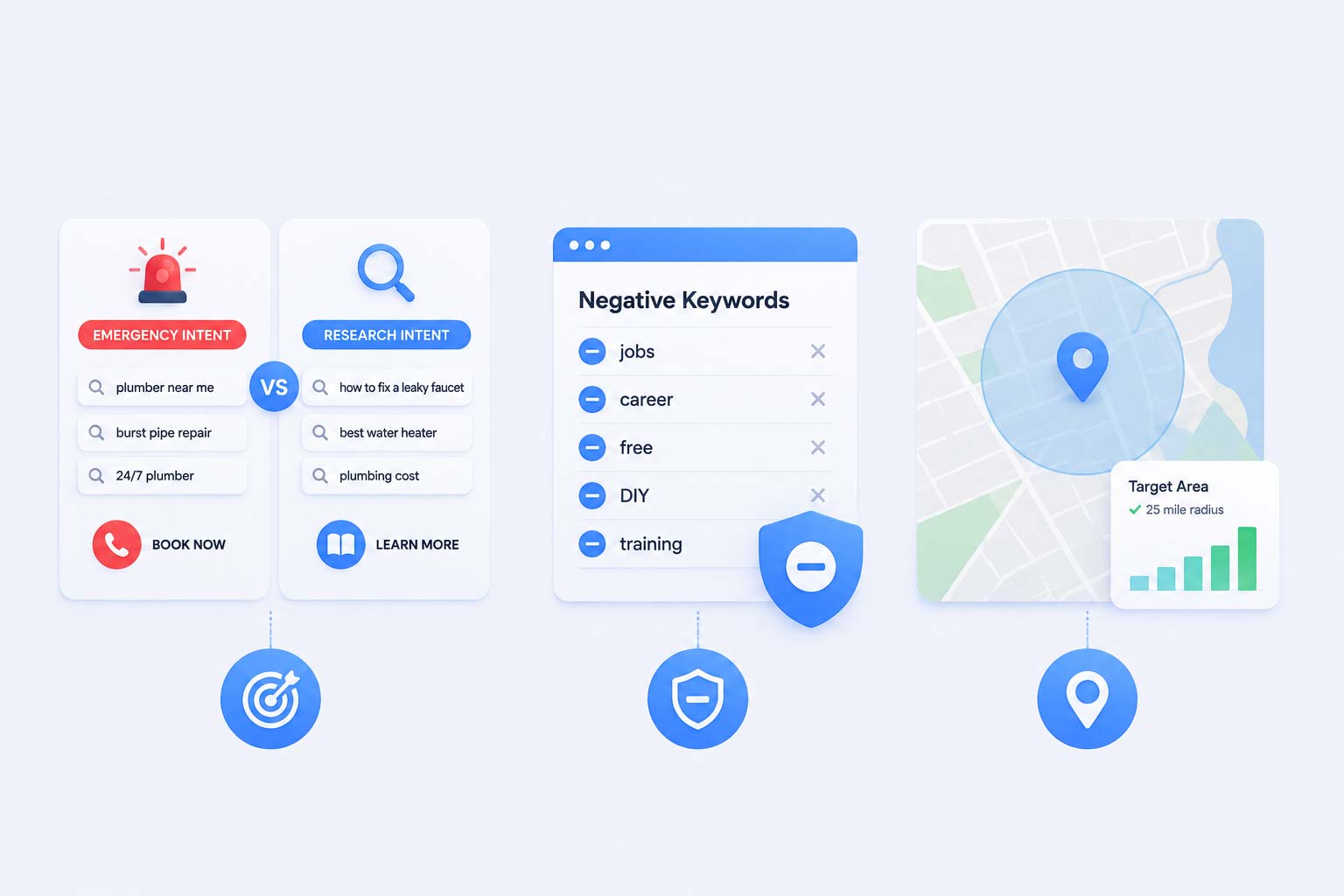
Emergency and research searches should never share a campaign, because they justify entirely different bids, ad copy, landing pages, and hours.
Someone searching for an emergency repair at 2 am and someone comparing replacement systems on a Sunday afternoon are different buyers. The first pays a premium for availability and decides in four minutes. The second reads three pages and calls Tuesday.
Ad scheduling follows. Overnight coverage is justified only if someone genuinely answers overnight; otherwise it is a budget leak dressed as availability. This ties back to the cost tiers: your emergency campaign runs a higher cost per click and belongs against a different cost-per-booked-job target.
The most expensive clicks in home services are the ones you never intended to buy.
Group negatives into categories rather than chasing individual terms:
This is the highest-return hour available in the account, because a list built once protects every campaign afterward. Discipline matters more in 2026 than under manual bidding, since broad match plus automation widens the pool of searches your ads can show for. Read your search terms report monthly.
Most contractors target a radius wider than the area they can profitably serve, then pay for leads they decline or lose money fulfilling.
Drive time is the real constraint, not mileage. Fifteen miles in South Florida means something very different at 7 am than at 5 pm on I-95, and a job that pencils at 20 minutes of travel does not pencil at 55.
Then check your targeting setting. Google's location documentation explains that broad geo targeting, labeled "Presence or Interest," reaches "people who not only exist in your targeted locations, but have shown an interest in your targeted locations," and suggests considering "Presence" when you only want users actually in those locations. For a plumber, someone in another state researching your city is not a customer.
The short answer is that your cost per booked job has less to do with your cost per click than with what happens in the ninety seconds after the phone rings.
Make the chain explicit, because most reporting stops one link short. Cost per click produces cost per lead. Cost per lead plus close rate produces cost per booked job. Only the last number is real money, and it is the one nobody puts on the dashboard.
Speed to lead is the dominant variable. Contractors who respond in minutes book substantially more of the same leads than contractors who respond in hours.
Landing page conversion is the second lever. Send ad traffic to a page built for that service, phone number visible without scrolling, fast mobile load, and review proof near the call to action. Our breakdown of a high-converting landing page covers the rest. Sending every ad to the homepage is the most common and most expensive mistake in this industry, and it is where most home services ad budgets leak.
That reframes the question you started with. It was never whether paid search is expensive. It is whether the operation behind the phone can convert what it delivers.
UADV builds home services campaigns around cost per booked job rather than cost per click. The difference between those two numbers is where most contractor budgets quietly disappear.
Specifics rather than claims. UADV has operated since 2014, is a Forbes Agency Council member agency, and works primarily with hospitality and local South Florida service businesses across Hollywood, Fort Lauderdale, Miami, Hialeah, and Pembroke Pines. Founder Alex Quin is a full-stack marketer and Forbes Agency Council member with bylines in Forbes and Entrepreneur.
What the work looks like: budgets split by trade tier so spend reflects what each service really costs, campaigns separated by service line, negative keyword lists built before launch rather than after the first wasted month, and a post-click audit of call handling and landing pages before anyone recommends raising media spend. Where an account needs ongoing campaign management, that follows the audit, and where the question is channel mix we compare SEO and Google Ads separately. Contractors on the build side can start with our construction marketing agency work or the trade-specific guide to digital marketing for plumbers.
The migration is a concrete reason to want help now. Moving from per-category bidding to one campaign-wide target makes account structure a specialist problem for anyone running more than one service line, and the window to restructure is the notice period before migration. Running this channel well is mostly a discipline problem, and discipline is easier to buy than to build while you are also running crews.
PPC for home services is neither expensive nor cheap in the abstract. It is priced per trade, and profitable only when your close rate and response time can carry the cost.
You should now be able to make four decisions: whether your margins support the channel, what your trade tier actually costs against a dated benchmark, which of the three ad formats fits your service mix, and whether your post-click operation is ready.
The Local Services Ads migration consolidates home services advertising into a single, more automated platform, which raises the value of the things automation cannot do. Answering fast. Structuring accounts deliberately. Knowing your own numbers well enough to tell a bad quarter from a bad channel.
If your account has not migrated yet, that notice window is the moment to act. Book a strategy session with UADV to review your trade-level numbers and account structure before your migration date, so restructuring happens on your schedule rather than Google's.
The contractors who win at PPC for home services are rarely the ones spending the most. They are the ones who know what a booked job costs them and answer the phone.
For most established home service businesses, yes, provided average job value and close rate can absorb trade-level lead costs. Paid search converts cash into leads at a knowable rate, so the real question is whether your margins make that trade profitable. Fix slow lead response before you fund a campaign.
LocaliQ's 2025 home services benchmarks, based on 3,211 US campaigns, report a median cost per click of $7.85 and cost per lead of $90.92. Garage services sit lowest at $5.75 per click and electricians highest at $12.18. Management fees sit on top of media spend and should be budgeted separately.
Local Services Ads charge per lead rather than per click, run without keyword targeting, and require verification that Google says may include license, insurance, and background screening. Standard Google Ads charge per click and give you keyword-level control over which searches trigger your ad. Most contractors eventually run both formats.
Google began migrating Local Services Ads into the main Google Ads platform in August 2026, starting with select US home and storefront services. Campaigns become a pay-per-lead Performance Max campaign type, and manual bidding gives way to a single campaign-level target. Export your historical performance reports before your migration date.
A good cost per lead is any number below your maximum allowable cost per acquisition, which depends on average job value, gross margin, and close rate rather than an industry average. LocaliQ reported roughly a five-fold spread between cleaning and roofing in one 2025 dataset. Both can be excellent buys.
Plan on ninety days before you have an honest read. The first month buys data, the second buys correction based on that data, and the third is the first month that reflects a properly tuned campaign. Judging at day thirty is why contractors abandon the channel right before it works.
UADV manages paid search for local service businesses across Hollywood, Fort Lauderdale, Miami, Hialeah, and Pembroke Pines from its Hollywood, Florida headquarters. The agency has operated since 2014 and is a Forbes Agency Council member. Multi-service contractors benefit most from having account structure reviewed before their migration window opens.
.webp)
Our team will compare you to your biggest competitors in your industry across multiple points from SEO to social media so you can find strengths & weaknesses in your business.


