

Picture a Miami diner pulling up Apple Maps to find tacos in Wynwood and seeing a sponsored result with a blue halo at the top of the list. That moment is the entire reason ads on Apple Maps matter for any business with a physical location. The bidding pool is still thin enough that an early mover can buy attention at a discount.
These are paid placements that surface the moment an Apple Maps user searches for businesses or services nearby. They launched in summer 2026 in the United States and Canada through the new Apple Business platform. If you are a restaurant operator or local business owner, you have probably wondered whether this is just Google Maps ads with a different logo. It is worth your attention, and this guide explains exactly why.
UADV is tracking this rollout as a meaningful opportunity for South Florida restaurants and bars. What follows covers a clear definition, how the bidding works, how Apple Maps ads compare to Google Maps ads, and what an operator should do this week to prepare.
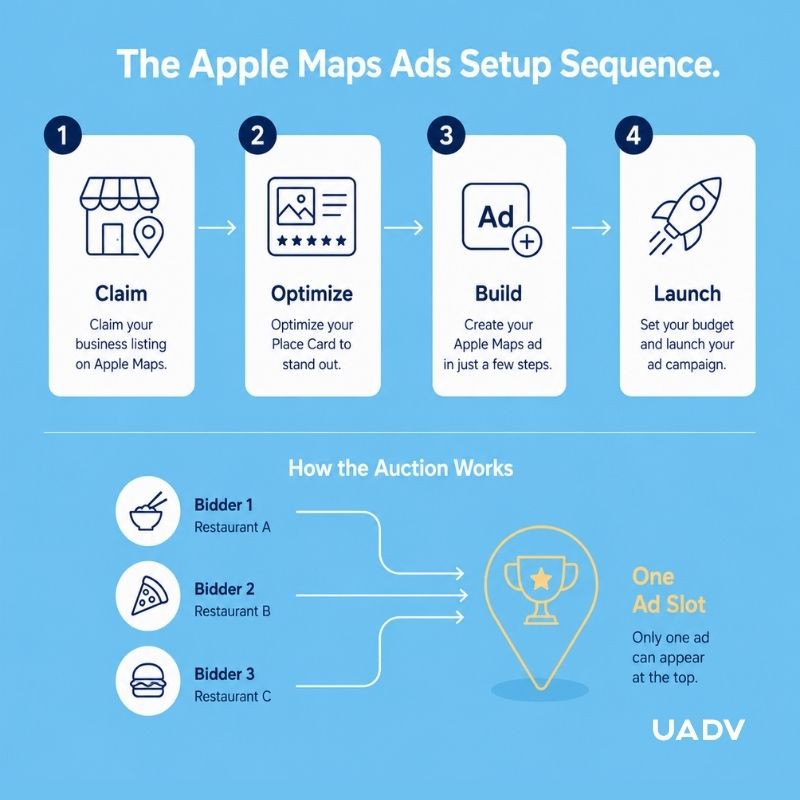
Ads on Apple Maps are paid placements that appear when users search for businesses or services in the Apple Maps app. They surface at the top of search results and inside the new Suggested Places experience, marked with a blue "Ad" label and a blue halo around the location's pin.
The visual treatment is specific, featuring one ad at most per search result view, identified by a light-blue Ad tag and a blue halo around the location's pin on the map. According to Apple's announcement, ads can also appear at the top of a new Suggested Places experience that displays recommendations based on what's trending nearby and recent searches. Geographic scope is limited at launch to the United States and Canada.
Here is what most people don't realize. Apple shows only one ad per search view, which means the auction is more selective and the placement more prominent than the equivalent slot on Google Maps.
Apple Maps ads share territory with Google Maps ads, although they follow a different rule. Apple's targeting works without the cross-platform behavioral data that powers Google and Meta, relying instead on contextual relevance to the search query and approximate location. Apple Maps does not associate the ad you see with your Apple Account, per the TechCrunch report on the launch.
Meta location ads optimize against feed-scrolling intent while Apple Maps ads optimize against active local search intent, which creates different funnel stages and different conversion patterns. The bidding is auction-based and pay-per-outcome, meaning advertisers pay when a user views or taps the ad rather than on impression alone.
The process comes down to four steps. Claim your Apple Maps listing through Apple Business, optimize the place card, build an ad through the automated creation flow, and set a budget you can start or stop at any time.
A business must have a verified Apple Maps listing before it can run ads. The listing is created and managed through the new Apple Business platform, which launched April 14, 2026 in over 200 countries and consolidated three existing services previously known as Apple Business Connect, Apple Business Manager, and Apple Business Essentials.
The bidding model is auction-based. Retailers and brands bid for ad slots against specific search queries such as pizza, plumber, or sushi. The highest relevant bid wins the single ad slot for that query. Targeting is matched on the search query and approximate location. Larger advertisers using the existing Apple Ads experience can layer scheduling and location targeting on top.
Before running any ad, a business needs a claimed and verified Apple Maps location through Apple Business, complete business details, accurate hours, a primary category, and at least a handful of high-quality photos. Apple is explicit that listing quality directly affects both visibility and ad eligibility, and an incomplete place card is one of the fastest ways to underperform before a campaign even launches.
Verification options include phone, email, or postcard, with documentation sometimes required. Verification can take days, so claiming early is a real timing advantage. Photo quality is a sleeper variable. Apple is actively encouraging businesses to upload imagery before ads go fully live, which suggests creative quality will influence ad rendering. For restaurants, that means food, interior, exterior, and atmosphere shots.
Small businesses get a fully automated campaign creation flow inside Apple Business. Choose a location, upload photos, write a promotional message, set a budget, launch. Larger advertisers and agencies can route through the existing Apple Ads platform for advanced controls. Campaigns can start and stop anytime, budgets are operator-controlled, and there is no minimum spend requirement noted in the current documentation.
The privacy guardrails matter for advertisers too. Age and gender are not used for targeting, accounts registered to minors under 13 are excluded by on-device logic, and personal location history is not available as a targeting input. What sets Apple Maps ads apart from Google Maps ads is that Apple's auction is privacy-first by design, placing bids on the search query and approximate area rather than a behavioral profile.
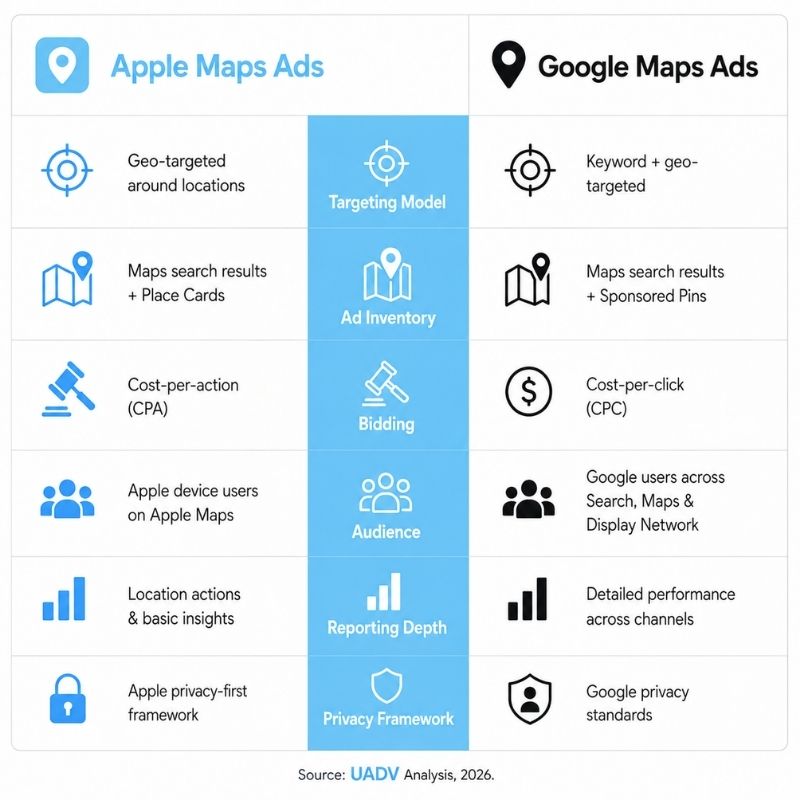
Every operator is privately running this comparison in their head. In short, Google Maps ads optimize for behavioral targeting and breadth. Apple Maps ads optimize for moment-of-search intent and prominence.
Audience differences are real. Google Maps still owns the larger share of total mobile map queries, although Apple Maps reaches an iPhone-skewed audience that runs higher in income and engagement in markets like South Florida and the Northeast.
Ad inventory differs too. Google Maps shows multiple sponsored results plus promoted pins. Apple Maps ads show one ad per search view. Lower volume, higher prominence. Reporting maturity is uneven. Google Ads has a decade of reporting depth and benchmarking. Apple Business reporting is newer and thinner.
Think of these as complementary platforms rather than substitutes. Most local businesses with budget will run both, with allocation determined by audience and category.
Apple Maps ads win when the audience skews iPhone, when the search is high-intent and category-specific such as food, drink, urgent care, gas, salon, or hotel, and when the operator wants ad placement without cross-platform behavioral targeting. Every new ad platform follows a similar curve. Early adopters get cheaper clicks before competitive bidding catches up. The window for advertising on Apple Maps is open right now.
Google Maps ads still win on inventory volume, audience breadth, reporting depth, integration with the broader Google Ads ecosystem, and conversion tracking maturity. For businesses already running an integrated Google Ads program, Google Maps is a natural extension. Apple Maps benchmarks are still being built, and operators should plan for a learning period in the first 60 to 90 days.
Apple Maps ads are best for businesses that depend on local foot traffic, in-person visits, or location-based services such as restaurants, bars, hotels, retail, salons, urgent care, and service businesses with a physical address.
Strong fits include full-service restaurants, bars, cafes, dinner-show concepts, hotels, boutique retail, salons and spas, urgent care, auto services, and fitness studios. The common thread is high-intent local search that drives revenue. Multi-location franchises with consistent setup and creative can move quickly across markets, and gain meaningful early-mover advantage.
Softer fits and poor gifts include pure e-commerce with no physical location, B2B with long sales cycles, and professional services driven primarily by relationships. For these, Google Search and Meta usually outperform map-based ads. Better fits are sub-metro neighborhoods and category-specific queries where the auction is thinner.
Restaurants and hospitality brands get the strongest results from Apple Maps advertising because search behavior around queries like "Italian restaurant near me," "rooftop bar Wynwood," or "best dinner Hollywood FL" is exactly the high-intent moment these ads are built to serve. The conversion path is shorter too. A Maps user can call, navigate, view the menu, or place an order from the ad's place card without leaving the app.
UADV's lead vertical is food and hospitality, with clients across South Florida, and the firm is preparing playbooks specifically for restaurant operators tracking this rollout. The visual creative angle matters more on a Maps ad than on a Google Search ad because the place card is the ad.
Skip Apple Maps ads when you don't serve customers locally, when your conversion path doesn't run through a physical location, or when your category sees almost no Apple Maps search volume. If you're already underspending on Google Maps and Google Business Profile optimization, fix that foundation first.
Apple Maps ads work best as an addition to a mature local strategy,, not as a replacement for one. Even good-fit businesses should plan for a 60 to 90 day test before scaling. Treat the first quarter as data collection.

At UADV, ads on Apple Maps are treated as a layer in a complete local marketing stack, not a standalone campaign, sequenced behind a fully optimized Apple Business listing, a strong Google Business Profile, and a tested Google Maps ads program.
UADV is a Forbes Agency Council member agency headquartered in Hollywood, Florida, leading with food and hospitality clients across Hollywood, Fort Lauderdale, Miami, Hialeah, Pembroke Pines, and the Treasure Coast. That deep hospitality focus shapes how the agency approaches Apple Maps advertising for its local clients.
The UADV setup sequence is deliberate. Claim and complete the Apple Business listing first, audit and align name, address, and phone across Google, Yelp, and the website, upload a strong photo set covering food, interior, exterior, and atmosphere, then build the ad with a search-query-driven message. Local brands benefit from category-specific copy, such as "handmade pasta Hollywood FL," over generic "best restaurant" framing.
Alex Quin, UADV's founder and CMO, is a Forbes Agency Council member with bylines in Forbes and Entrepreneur, which gives the agency unusual visibility into how local ad platforms shake out in the early months. Restaurant operators should reach out when an existing Google Maps program is mature and an iPhone-skewed audience is meaningful. That is the point at which Apple Maps ads become the natural next layer in the stack, rather than a first attempt at local advertising.
The preparation comes down to five steps. Claim your Apple Maps listing, complete your Apple Business profile, audit your name, address, and phone across listings, upload high-quality photos, and prepare a short list of priority search queries for your category.
Most operators have the same four questions about Apple Maps ads, and the honest answers are simpler than the platform's newness makes them feel. How much do they cost? How do I measure them? Will they cannibalize my Google Maps spend? How long until I see results? The full FAQ block below covers a wider list, although those four come up repeatedly in agency conversations.
Ads on Apple Maps are paid placements that appear when users search for businesses or services inside the Apple Maps app. Apple shows one ad per search view, marked with a blue Ad label and a blue halo around the location's pin. They launched in the U.S. and Canada in summer 2026.
Apple Maps ads use an auction-based bidding system, with advertisers paying when a user views or taps the ad rather than per impression. There is no published flat rate, and costs depend on the search query, local competition, and category. Early bidding pools stay thin in many categories, often meaning lower entry costs.
The main differences are targeting, inventory, and audience. Google Maps uses cross-platform behavioral data and shows multiple sponsored placements. Apple targets based on the search query and approximate location, and shows one ad per search view. Google has the larger total audience, while Apple has the iPhone-skewed, privacy-first audience.
Any business with a verified Apple Maps listing can run ads through the automated creation flow inside Apple Business. There is no published minimum spend, and campaigns can start and stop anytime. Small operators benefit most from category-specific search terms and complete profiles with strong photos that match the placements they want.
Start at business.apple.com, sign in with an Apple ID, and either claim an existing listing or add your business as new. Complete the place card with your official name, address, phone, hours, primary category, photos, and links. Apple verifies via phone, email, or postcard, which can take several days, so claim early.
For most full-service restaurants, bars, and hospitality groups in South Florida, yes. The audience iPhone share is high, and local search behavior matches the ad placement. UADV, a Forbes Agency Council agency in Hollywood, Florida with a hospitality vertical lead, treats Apple Maps as a layer in a complete local stack.
Apple Maps ads are built to a privacy-first standard. The ads a user sees and interacts with are not associated with their Apple Account, personal data stays on the device, and Apple does not share it with third parties. Targeting works on the search query and approximate location only.
Every new local ad platform has the same arc. Early movers get the cheap clicks, the high visibility, and the data advantage. Late movers pay for both the bids and the lost time. Advertising on Apple Maps stands apart from Google Maps as a privacy-first, single-slot, high-intent placement on a platform with hundreds of millions of US iPhone users, and the bidding pool is still thin.
The businesses that prepare their Apple Business listing now will be the ones running ads on Apple Maps profitably by Q4 2026. These ads launched in summer 2026 in the U.S. and Canada, run through Apple Business, surface one ad per search view, use auction-based pay-per-outcome bidding, and fit local foot-traffic businesses best.
Restaurant and hospitality operators in South Florida should book a strategy session with UADV to map their Apple Maps ads sequence alongside their existing Google and Meta programs. The operators who win this channel are not the ones with the biggest budget. They are the ones with the cleanest listing, the strongest photos, and the sharpest list of search queries. Any disciplined operator can build that list in a week.
.webp)
Our team will compare you to your biggest competitors in your industry across multiple points from SEO to social media so you can find strengths & weaknesses in your business.


